Showing posts with label Humanities. Show all posts

Friday, January 10, 2014

Humanities Council Now Accepting Board Member Nominations

An Invitation to Serve, An Opportunity to Connect
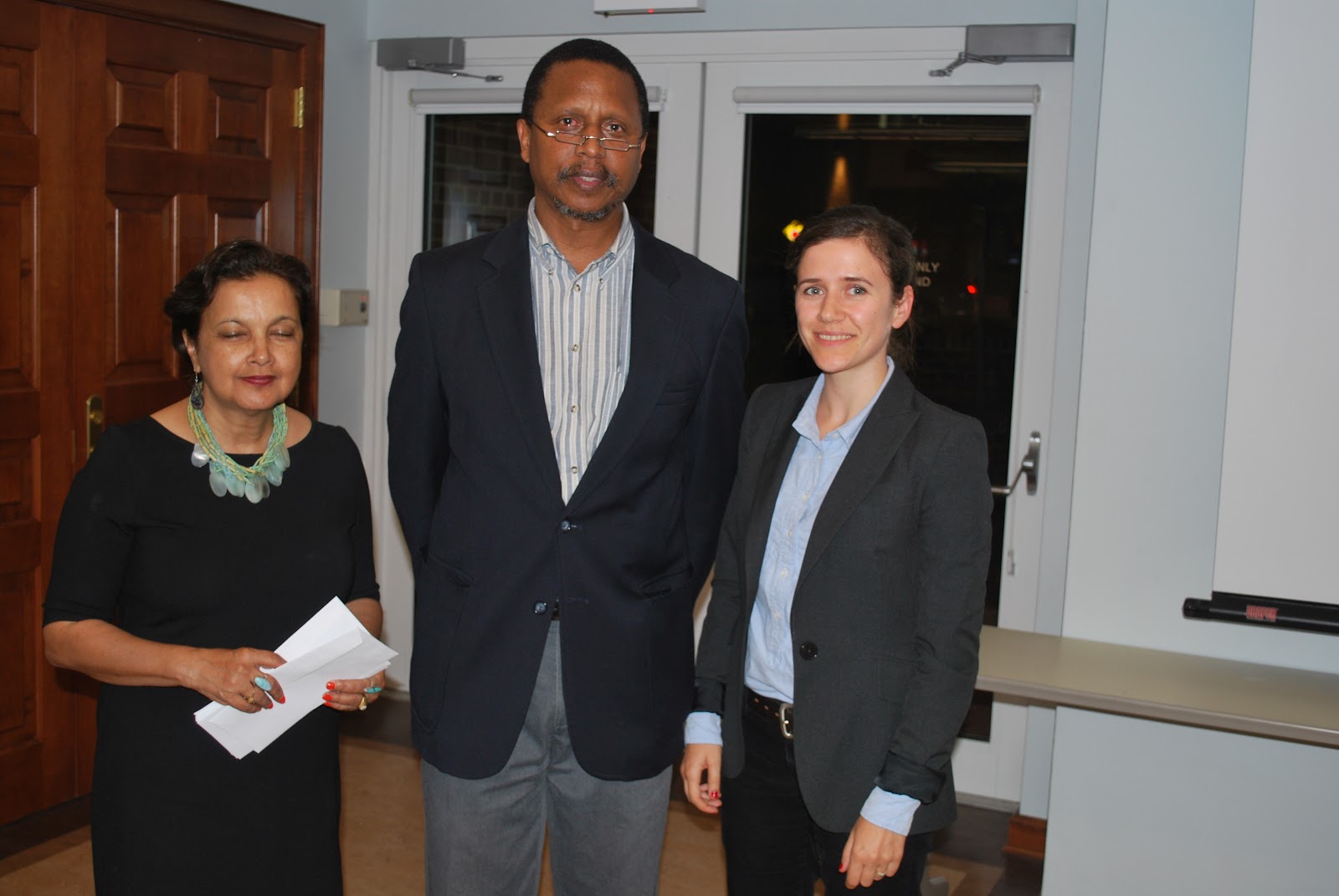
Board Chair Bradford Grant distributes grantee awards with
Executive Director, Joy Ford Austin (left).
The Humanities Council of Washington, DC seeks nominations to its Board of Directors. All nominees must be residents of the District of Columbia.  Nominations should be accompanied by: a resume and a letter explaining why the nominee would be a valuable addition to the Board.  Nominees can be recommended or self nominated.

Board Members are appointed for a three-year term, with re-nomination possible for a second term.  Commitments include
Stewardship of this 34 year old organization that provides humanities programs and grants to city residents 
Financial support
A passion for promoting the humanities

Benefits include outstanding opportunities to connect with people across the city who are civically engaged and enjoy participating in the city’s life.

In electing individuals to serve, the Council strives for geographical and ethnic representation, and for balance between academic and public spheres.  From the academic sector, the Board elects teachers, scholars, and educational executives. Public nominees represent a variety of professional backgrounds, including but not limited to business, labor, law, technology, public relations, and cultural and civic organizations.  Board Members serve without compensation.

Please e-mail your information by January 31st to:
Mr. Gregory Jefferson, Chair, Nominations Committee
Humanities Council of Washington, DC
 
The Humanities Council has a proven track record for sparking civic dialogue and reflection using the humanities disciplines. Centered in our Nation’s Capital, we reach over 250,000 citizens every year, including 17,000 children through our grants and programs,  The Council is an affiliate of the National Endowment for the Humanities; however it is a private, non-profit organization and not a federal or District agency. 

The mission of the Humanities Council is to enrich the quality of life, foster intellectual stimulation, and promote cross-cultural understanding and appreciation of local history in all neighborhoods of the District through humanities programs and grants.  The Humanities Council of Washington, DC transforms lives through the power of the Humanities..


Thursday, October 24, 2013

First Who's a Washingtonian? Grants Awarded Tonight

10 Organizations To Receive $5000 for Projects Promoting Understanding and Collaboration Through the Humanities


The Who's a Washingtonian? grant was created this year to support projects that actively seek to spark dialogue between groups of residents that have been isolated from one another either geographically or culturally. Using the humanities disciplines as lenses, these projects will help Washingtonians better understand the ties that bind them such as music, literature, history, religion, and language.

Alliance for Global Justice - A Conversation at the Lincoln
This project will bring senior citizens with an intimate connection to the Lincoln Theatre's past together with young up-and-coming performers who have been featured
on the historic stage, to discuss the iconic landmark's importance in defining a sense of community, identity, and place in the greater U Street area.

Capitol Hill Arts Workshop - This Neighborhood has a Face: Talking Pictures
CHAW will engage a historian to collect images, videos, oral histories, and other materials from longtime and newer residents of the Canal Park neighborhood. The historian will augment the collected materials with archival research, that will culminated in a daylong celebration of the neighborhood and its residents.

Center for Inspired Teaching - Dream City Revisited
CIT will create an instructional module for educators teaching 12th grade Washington, DC history that will ask students to read from the book, Dream City: Race, Power and the decline of Washington, DC. Students will then interview residents who lived in the city from 1960-1990 to gain further perspective.

Georgetown Day School/Lincoln Temple United Church of Christ -Preserving the Past/Protecting the Future
This program will bring the students and members of the Lincoln Temple congregation together to document, preserve, and learn from the church's rich and vibrant past.

Grassroots DC - Potomac Gardens Inside and Out Documentary Project
This program will explore the persistent divide between the residents of the Potomac Gardens housing complex and the changing population of the surrounding neighborhood. It will seek to identify the barriers to communication between these two groups of neighbors and the means to mitigate them.

Historical Society of Washington, DC - Urban Photography Series
This program brings residents together around the photographic preservation of the city's streetscapes. HSWDC will hold workshops to teach best practices in urban photography and feature participants' work in an educational exhibit.

Life Pieces to Masterpieces - LPTM Color Me Community Conversations
This series of conversations is designed to engage people from all walks of life in an exploration of the common challenges faced by residents of the DC metro area.

ONE DC  - From the Streets to the Rooftops: Perspectives on a Changing City
This series of public events will bring together long-time and newer residents of the Shaw neighborhood to explore the dynamics of urban renewal and displacement in DC.

The Theatre Lab School - Teenaged DC: Life Stories Then and Now
This drama program will pair senior citizens with middle school students, who will, together, explore the past and present of adolescence. The seniors will talk with the students about their teenage memories, and the students will act out the stories as part of a public performance in May 2014.

University of the District of Columbia - Tally's Corner TALKS
This project will revisit a 1967 ethnographic study by Elliot Liebow entitled Tally's Corner: A Study of Streetcorner Negro Men that transformed the way policy makers understood urban poverty and race in America. Liebow's research focused on a group of black men who lived, loved, and labored in the neighborhood surrounding the corner of 11th and N Streets NW in Washington, DC. "TALKS" hopes to inspire dialogues among the many different ethnic and socioeconomic groups that now call this neighborhood home.

Wednesday, October 2, 2013

Humanities for Sale

Bid on These Unforgettable Humanities Experiences Today

On October 1st, the Humanities Council will launch their first-ever online Humanities Auction! The Humanities Auction will feature exclusive, one-of-a-kind, humanities-based experiences. The funds raised through this auction will go to support the Humanities Council and our mission to enrich the quality of life in Washington, DC. Our organization serves over 430,000 DC residents through our public programs, educational initiatives, grant programs, and the online DC Digital Museum. Your support for our auction will help us serve even more residents, increase our programs and grants, and engage our city’s youth in discovering DC’s rich history and culture.

Visit the auction website at http://www.32auctions.com/organizations/9874/auctions/10815 to browse our exciting line up of humanities-based services and experiences!

Tuesday, April 17, 2012

Today in the Humanities... A History Resource for Students, Cambodian Archaeology, and Pulitzer History

Humanities Stories from Around the Globe to Pique Interest and Spark Conversation!


Patrick Awuah makes the case that a liberal arts education is critical to forming true leaders.


A major stop for runaway Southern slaves, Washington, DC, attracted large numbers of blacks after the Civil War. By 1960 the city had a majority black population. The presence of black political organizations and the large marches in the 1960s made Washington a major center of the civil rights movement. Today it is one of the largest and most prominent black-dominated communities in the United States.


Count Basie and Bob Crosby
at the Howard Theatre,
Gottlieb Collection, Library
of Congress
George Clinton surveyed the crowd Tuesday night and let out a soulful sigh: “Boy, do I have memories in this joint!” The legendary purveyor of funk, looking notably tidier sans his equally legendary Technicolor dreadlocks, took the Howard Theatre stage at the historic venue’s VIP grand opening concert and celebration following a $29 million renovation.


A team of young archaeologists from the Faculty of Archaeology at the Royal University of Fine Arts and from the Royal Academy of Cambodia initiated a yearlong project that combined: excavation, cultural resource management and the construction of a museum in order to preserve, document and disseminate information about the rich cultural heritage of the Sre Ampil site.


The Humanities Council [of North Carolina] has been revisiting the notion of The American Dream. During this process we decided to take the conversation outside (literally) and engage folks in conversation around this broad but universally relevant topic. 


“Pulitzer history, of sorts, was made this year when the Pulitzer Board announced that no prize for fiction would be awarded this year,” says Corrigan, who has been published in the New York Times, written a book and writes a mystery book column for the Washington Post.

Thursday, June 9, 2011

Human vs. Machine - History Theatre Version

Is a Human or a Robot More Suited to Teach Us About the Past?

Frederick Douglass' life is regularly taught to school children through living history theater. In 2008, THEARC DC received a grant from the Humanities Council to carry on this tradition in a whole new way; their performance made use of a life-sized animatronic Douglass. In 1992, the Humanities Council supported a living history performance in which Frederick Douglass was portrayed by actor and educator Fred Morsell. Morsell was able to teach the students about Douglass' life before getting into character, and was able to resolve the performance as himself at the end. Check out the footage from both events to compare and contrast. Which is the better method of teaching about Douglass' life? Is there room for both animatronic and flesh-and-blood human living history performances? What are the benefits and challenges associated with either method.

Animatronic Performance at THEARC DC


Morsell's Performance at Orr Elementary

Thursday, April 21, 2011

Live to Read Selection Inspires Art and Poetry

Don't miss this exciting blend of literature and art!

After reading Ruined by Lynn Nottage, participants in the Miriam's Kitchen art therapy program created works reflecting the play's themes and imagery. The exhibition entitled, Courageous Vision, will be on display this evening at the Shaw Whole Foods on P Street, NW. The third and final exhibition of the art show will commence at the Georgetown Whole Foods on Thursday, April 28th. Both events are completely free and do not require registration.

About Miriam's Kitchen
Miriam's Kitchen was founded in 1983 by a collaboration of The George Washington University Hillel Student Association, Western Presbyterian Church and United Church in response to an urgent need for services for the homeless in Washington, DC. Our mission is to provide individualized services that address the causes and consequences of homelessness in an atmosphere of dignity and respect, both directly and through facilitating connections in Washington, DC. We provide free, homemade meals and high-quality support services to more than 4,000 homeless men and women each year through our core programs: Meals, Case Management, Miriam's Studio, and Miriam's Cafe.


This series of programs is the Humanities Council's annual celebration of literature and city-wide read. All Washingtonians are encouraged to participate in the series of discussions, workshops, and live performances held by the HCWDC and its partners which focus on a single work of fiction. 

Tuesday, April 19, 2011

Remembering the Black Fashion Museum

Collection Will Reemerge as Part of the Smithsonian National Museum of African American History and Culture


The Black Fashion Museum was founded in 1979 by Lois Alexander Lane in a Harlem brownstone. Lane was a dedicated fundraiser and curator, and managed to expand her wealth of culturally and socially significant artifacts for nearly 30 years. In 1994, the museum moved to Washington, DC where Lane eventually established it in a one hundred year old row house at 2007 Vermont Ave, NW - just around the corner from the Humanities Council. After Lane's death, her daughter Joyce Bailey sought to continue her mother's efforts to expand the organization's collection and reach, but the cache of dresses, coats, hats, and other garments designed and sewn by slaves, famed Hollywood designers, Civil Rights leaders, and First Ladies' seamstresses, had begun to outgrow the Vermont Avenue facility. In 2007 Bailey donated the important collection of Americana to the new Smithsonian National Museum of African American History and Culture.

This episode of Humanities Salon honors Anne Lowe, a noted African American clothing designer who created Jacqueline Bouvier Kennedy's iconic wedding dress in 1953. It was filmed at the Black Fashion Museum in 2002, and includes several notable panelists including Lowe's great granddaughter and Washington Post fashion editor Robin Ghivan. Ghivan wrote an outstanding article on the Black Fashion Museum and its important, yet overlooked, collection in 2007, as it was moved to the secure and climate-controlled facilities of the Smithsonian.


The National Museum of African American History and culture is scheduled to open in 2015.

Friday, February 18, 2011

Black History Month Feature: Jacob Lawrence and the Migration Series

Southern African Americans' Trek From Rural South to Urban North Documented on Canvas

Artist Jacob Lawrence painted the
"Migration of the Negro" series
from 1940-1941
During World War I, many African Americans took up arms to defend their home country despite the fact that their equal participation in its government was severely crippled by southern Jim Crow legislation and Ku Klux Klan led terrorism. When they returned home after the armistice, they justifiably expected that their sacrifices would be rewarded with increased rights and equality. 14.4% of African Americans who served during the war lost their lives, but the bloodshed did not end when the survivors returned home. In 1919, of the 70 African Americans who were lynched, 10 were veterans who had fought to preserve the freedoms of their murderers.1 

These injustices were just one factor sparking the first Great Migration of African American families from their long-time homes in the southern United States to the urban industrial centers of the north. Seeking relief from social and economic repression these migrants sought factory jobs in cities like Chicago, Detroit, Cleveland, New York City, and Washington, DC. This movement was not undertaken without a great deal of courage and pain. Most black families were leaving the only homes they had ever known for unfamiliar urban spaces. Hopes of greater social equality were soon mitigated by restrictive real estate covenants and hastily replicated Jim Crow-type restrictions, and tensions mounted with recent immigrant populations with whom they for jobs and housing. 

Amidst all of this turmoil, a flourishing of the African American arts scene was in full swing in the upper Manhattan neighborhood of Harlem. A young artist black artist named Jacob Lawrence had a front-row seat to the Great Migration and its effects. He painted series of panels illustrating the era, including the hardships of sharecropping labor in the south and the violence of race riots in the urban north. The panels, and the captions composed by Lawrence for a studio showing of his work represent a vivid crystallization of memory. Though they are indeed the visions of one individual, they capture the spirit of many, perhaps even better than a photograph.


Lawrence's panels were purchased by the the Museum of Modern Art in New York, and the Phillips Collection in Washington, DC. In 1995, the Phillips created an education series based on the panels with a grant from the Humanities Council of Washington, DC. The resulting documentary film includes interviews with Jacob Lawrence, and a unique analysis of his striking visual representation of history.

1. Digital History, The Great Migration, University of Houston: 2006, www.digitalhistory.uh.edu; accessed: 2/17/2011

Monday, February 14, 2011

Black History Month Feature: What's In a Name? Profiles of the Trailblazers

Publication Documents the History of DC's Public and Public Charter School Names


The Women of the Dove Foundation has received several grants from the Humanities Council over the last few years to produce a remarkable history of the District's Public and Public Charter School names. Washington, DC has had a substantial African American population since it was founded, and it was one of the first cities to feature publicly funded schools for black students. Because of this unique history, Whats In a Name: Profiles of the Trailblazers, reveals a strikingly deep, multi-layered story.

There are schools all around the country bearing the names of figures such as Woodrow Wilson, Rutherford B. Hayes, the Marquis de Lafayette, and Benjamin Franklin, and their DC counterparts are all featured in Women of the Dove's survey, but Washington's schools have also carried the monikers of Benjamin Banneker, Francis Lewis Cardozo, and Alexander Crummell. Women of the Dove has rightly observed the necessity of preserving not only the name, but the person whose words and deeds earned them that memorial.

Most Washingtonians know that Banneker surveyed the original boundary lines of the Capital City, but Banneker was also an inventor, mathematician, astronomer, and is recognized in What's In a Name? as “one of the first African Americans to gain distinction in science.” Cardozo was the first African American to hold statewide office when he became the Secretary of State for South Carolina during the Reconstruction era. He later became principal of Washington, DC's Colored Preparatory High school, where he introduced curricula that would transform the school into one of the best for African Americans in the country. Crummell was the son of a slave father and a freeborn mother, who became an eminent educator and clergyman. A professor at Howard University, he founded the American Negro Academy, an organization that encouraged African American scholars and writers to publish and disseminate their works.

Alexander Crummell School in Ivy City, Washington, DC
Recovering the human story behind building names is only one layer of the historical narrative explored by Women of the Dove. Using the names as entre, their publication examines the nuances of Washington's segregated school system, and explores the changes it experienced after the 1954 Bolling v. Sharpe Supreme Court decision that held segregation to be unconstitutional in the federally controlled District of Columbia (Brown v. Board of Education was decided on the the same day). What's in a Name provides a brief history of each school, often characterized by its status as a formerly all-black or all-white, and what happened to it after integration.

The entire publication is available online through the DC Digital Museum. Look up your school, you parents' school, your kids' school; you may be surprised at where the name above the door actually comes from. Read the histories of all the schools to begin to piece together the history of Washington, DC's storied public school system. Let us know what you think. Leave a comment about the publication or about your own experience in DC Public Schools past or present.

For more information on the history of segregated schools in Washington, DC, check out Wide Enough for Our Ambitions, an online exhibit curated by Kim Roberts for last year's Washington, DC Big Read.

Wednesday, February 9, 2011

Black History Month Feature: The Emergence and Legacy of African American Basketball National Conference (Program Brochure)

Black Basketball Has Strong Roots in the District

Image Source: Tinner Hill Heritage
Foundation
Dr. Edwin Bancroft Henderson, a native Washingtonian, graduated from Harvard University's School of Physical Training in 1904. Upon his return to the Capital, he became the athletic director for the city's segregated African American school system for which he founded the first school athletic league. Henderson's players met at the 12th Street YMCA founded by Anthony Bowen. Henderson believed that basketball would help African American youth gain a measure of equality by building character and providing a path to higher education. In 1910, Henderson encouraged Howard University to accept his 12th Street YMCA squad as their first varsity basketball team. By the 1940s, largely due to Henderson's extremely competitive and popular athletic league, Washington, DC was widely recognized as the birthplace and hub of black basketball

Henderson's contribution to civil rights was not limited to the basketball court, The Tinner Hill Heritage Foundation is a non-profit organization founded by Henderson's descendants in Farifax, Virginia. The organization's primary mission is to recognize Henderson and Joseph Tinner's fight to deter segregated housing in Fairfax County, and their founding of the precursor organization to the first rural branch of the National Association for the Advancement of Colored Persons.


Last year, Tinner Hill applied for a DC Community Heritage Project grant from the Humanities Council of Washington, DC to help fund a conference on the history of black basketball in the District. The event was held on November 12th , 2010 and featured such notable basketball figures as Earl Lloyd and Dave Bing. The Humanities Council funded the accompanying publication that surveyed the history of E.B. Henderson and his “12th Streeters.” The brochure is part of the DC Digital Museum, and can be viewed here (click on the links in the description).

Check out the informative publication to learn more about Dr. Henderson and black basketball in Washington, DC and let us know your thoughts by commenting on this post.

Wednesday, February 2, 2011

Black History Month Reveals the Gaps in the Historical Narrative

Is History More Complete Since the Days of Dr. Carter G. Woodson?

Carter G. Woodson
February is Black History Month, and the history of its observance is central to Washington, DC with its tradition of African-American scholars and scholarship. In 1926, Carter G. Woodson launched Negro History Week with the Association for the Study of Negro Life and History (now the Association for the Study of African American Life and History). Woodson lived and worked in the District, and had incorporated the ASNLH there 11 years earlier. He believed that mainstream education functioned as propaganda lifting the history and culture of Europeans over that of others. In a letter to Thomas A. Barnes justifying the ASNLH creation of a home study department, Woodson wrote:

“The fact is that the so-called history teaching in our schools and colleges is downright propaganda, an effort to praise one race and to decry the other to justify social repression and exploitation. The world is still in darkness as to the actual progress of mankind. Each corner of the universe has tended to concern itself merely with the exploits of its own particular heroes. Students and teachers of our time, therefore, are the victims of this selfish propaganda.”

Carter G. Woodson House, Washington, DC
Courtesy: Historical Society of Washington, DC
Woodson was the first child of enslaved parents to receive a PhD. from Harvard University, but was barred from teaching at his alma mater because of his race. He spent his post graduate years teaching in public schools before joining the faculty at Howard University. He was familiar with the U.S. education system at all levels when he created Negro History Week, and was determined to return blacks to the American historical narrative. In 1972 the name and scope of the celebration was changed to Black History Month.

During the past two or three decades, many scholars, educators, and journalists have challenged the relevance and validity of the observance, charging it with tokenism, exploitation, and intellectual segregation. The most common critique is that by relegating African-American history to a single month, it gives us license to ignore it for the other eleven. Some have written that Black History Month is used as a mere marketing tool; businesses put out banners, display photographs of Martin Luther King, Jr., and expect that their contributions will be rewarded with improved public sentiment. This collective empathy is central to the final criticism – that Black History Month is an empty obligation that makes us feel good and assuages guilt, but lacks any substance (largely attributable to the effects of commercialization). 

These arguments are likely all valid in some capacity, but their authors' desire to spot broad social trends often renders the actual accomplishments of Black History Month invisible. Negative reviews of Woodson's creation regularly overlook his original intentions, fail to evaluate whether those intentions are actually being achieved, and almost never suggest alternatives. 

Black History Month does not encourage the inclusion of an alternate historical narrative. By setting some time apart each year to study that separate narrative exclusively, it shows us that the accepted version of American history is quite incomplete without it. Highlighting black history for a set period emphasizes its absence elsewhere, but Black History Month does not cause this absence, it cries out for a remedy. 

Since its founding, but especially since the beginning of its nation-wide observation, Black History Month has gradually begun to fill the gaping holes in American history observed by Woodson in the 1920s. Recently, the Humanities Council of Washington, DC has featured some of its materials related explicitly to African-American history on HCTV and the DC Digital Museum catalog, but they are just two or three out of hundreds that could have qualified. Thanks to Washingtonian, Carter G. Woodson, and his insistence that we pay special attention to Black History for a dedicated period out of each year, few HCWDC grantees have been able to produce projects that exclude it; we simply cannot tell a story without including revelations gained from Black History Months past. Granted, DC has a unique history; for many years it has had a majority black population, and was home to free blacks before the Civil War. The fact remains, however, that Woodson and the ASNLH saw the need for improved black history education based primarily on their observations in the nation's capital. 

In 2011, the HCWDC (and likely many other cultural institutions around the country) would be hard-pressed to relegate emphasis of African-American history to a single month, but in the interest of advancing Woodson's cause and contributing to a still woefully incomplete mainstream narrative of American history, beginning tomorrow, we will highlight select items from the DC Digital Museum. Don't be surprised though, if the series outgrows February!

Tuesday, January 4, 2011

Mayor Gray is a Hand Dancer

Washington Post Article foresees a popularity spike for DC's Official Dance

Hand Dance holds the distinction of being Washington, DC's official dance according to a 2003 city council resolution sponsored by Phil Mendelson. A recent article in the Washington Post written by Nikita Stewart, indicated that the dance style's popularity may get another boost from the local government. It seems that recently elected mayor Vincent Gray is an avid hand dancer, and has been practicing the art form since his childhood. According to the article, Gray, who grew up in Northeast Washington, showcased his talents throughout his campaign. His dedication to hand dance could spark a revolution among DC dancers young and old. Some may hope to preserve the dance and the traditions it represents, and some may see it as an entrée to the local culture and community of which they hope to be a part.

The Humanities Council of Washington, DC awarded a 2010 DC Community Heritage Project grant to Beverly Lindsay-Johnson and the National Hand Dance Association for a documentary surveying the history of this descendant of the Lindy Hop and Jitterbug. The film, entitled Hand Dance: a Capitol Swing, was the result of an August 8th  oral history interview session that featured some of the most notable names in DC Hand Dance. The entire finished product is available through the Humanities Council's DC Digital Museum and Youtube channel. Lindsay-Johnson is also the producer of Dance Party: the Teenarama Story, a documentary film about Washington, DC's Teenarama dance program of the 1960s. The show was open to African-American youth unlike many of its contemporary counterparts. 

As Ms. Stewart demonstrates in her article, shared cultural traditions do not always function as bridges across generational and racial boundaries – not at first. But there also seems to be significant evidence that the world of hand dance holds a lot of potential. Like differing interpretations of a good book, the multitude of ways DC residents have adapted hand dance are likely to fuel debate and discussion among dedicated dancers and newcomers alike. Perhaps those discussions will be limited to the beat of the music, and the occasional trash talk challenge, but the longer people from differing backgrounds spend together, the more likely they are to find common ground.

Monday, January 3, 2011

Ethelbert on the Power of the Humanities

The Poet Offers Advice to The Mayor in the Washington Post

Image Courtesy Howard University
The beginning of a new year is a great time to reevaluate priorities, and the Humanities Council is glad to see that that poet E. Ethelbert Miller, in a Washington Post article last Thursday (page 3), has encouraged Mayor Vincent Gray to put the arts and humanities at the top of the administration's list of remedies for a fractured city. The humanities disciplines have the power to bring people together around shared historical narratives, common appreciation for works of literature, and philosophies that encourage understanding and cooperation.

Miller's three word imperative for the incoming mayor? - “Read a book.” It's advice that all District residents should take to heart. “People can come together around song and dance and celebrate our city's diversity,” Miller says. “As mayor, you should be seen walking around not just with budget reports but with a book of poems or a novel as well.”

Tell us what you think. Can the city government do more to encourage enriching arts and humanities programming in all wards? What role to the humanities play in bringing a culturally and socioeconomically diverse city together?

Wednesday, December 22, 2010

Melvin Deal Appears in People's District

Dancing Griot Discusses His Work With Community Youth

People's District founder, Danny, travels from ward to ward, neighborhood to neighborhood seeking stories. His findings, pieced together in his blog, form a living portrait of humanity, as poignant as it is raw. He doesn't look for subjects, but for friends, and fellow citizens. He does not ask questions; he listens and reports. The stories do not always glisten and shine, but they serve as a reminder that DC is populated by regular, everyday, unique, multi-dimensional characters. People's District lets readers get to know the city without giving them so much that they are not encouraged to go out and see it for themselves. 

Humanities Council honoree Melvin Deal was recently featured on the blog, discussing his work as a community youth leader, dance teacher, and cultural anthropologist. Deal, from his African Heritage Dance Center in Anacostia (formerly located in Deanwood), has helped countless children care escape neglect and self-doubt, encouraging them, through the performing arts, to be successful in all aspects of their lives. Click here for more information of the film, Dancing Griot: The Life and Legacy of Melvin Deal, funded, in part, through a Humanities Council of Washington, DC 30th Anniversary Special Grant. And check out the story and images captured by People's District inside Deal's Southeast dance studio.

As he continues to seek-out the agents of grassroots history, heritage, and culture in Washington, DC, Danny will doubtless encounter many individuals who have been affiliated with the Humanities Council. The People's District is an impressive digital humanities project and we applaud the effort to preserve the District's collective memory.

Tuesday, November 30, 2010

Fifteen Minutes with Cindy Janke of the Franklin School Exhibition

HCWDC INTERN, ASHLEY PORTILLO INTERVIEWS THE CURATOR OF THE FRANKLIN SCHOOL EXHIBITION

Visit http://www.franklinschooldc.org/ to learn about the Franklin School Exhibition which was held at the Historical Society of Washington, DC. Visit the Franklin School at 13th and K Streets, NW in downtown DC.  Find out more about this project at our 4th Annual DC Community Heritage Project Showcase on Wednesday, December 8. You are guaranteed to learn something new about DC at this FREE program and reception! RSVP today!. 

Q: How did you become involved in preservation?

A: Oh my God it has been thousands of years (laughs)! As a child, I remember looking at people fixing up their houses. Then when we moved to Capitol Hill in 1969 and bought an old house, I got interested in the history of my own house and those of my neighbors.

Q: Did you grow up in DC?

A: No, I grew up in upstate New York, but I’ve lived here (in DC) since 1965. So I have some views of the past and present (laughs).

Q: Tell me a little bit about the significance of the Franklin School.

A: As I worked on the exhibition, Capitol Funding, I realized its significance for this city. It is an architectural landmark and educational landmark, as far as classroom design and educational programs. It made 19th century public schools respectable when they hadn’t been. Then, I got into 20th century history and I found that a lot of civil rights battles took place at the Franklin School. I knew it was a landmark but not one where the civil rights movement had taken place.

Image Courtesy DCist.com
Q: What challenges do you face on this quest to salvage the Franklin School?

A: Well, it used to be a homeless shelter. Some people want to reopen the Franklin School as a homeless shelter again. But that doesn’t solve the plight of the homeless. It’s available, it’s space, but it doesn’t solve the problem. It’s not suitable. In reopening the space, they could find something better if they tried. Things have to move along, you can’t just freeze everything. But this is a landmark- a National Historic Landmark.


Q: What is your vision for reviving this historical landmark?

A: There’s been talk about converting it into an adult graduate school or as a UDC Law School because these don’t require gyms and ball courts like a regular school does. And the rules prohibit the construction of gyms and courts. I would like to see the Franklin School serve some sort of cultural or educational function, maybe as a non-profit. We have two headquarter schools in DC. I mean, the Sumner School is great, but what about the Franklin School? We just can’t get rid of it. Sometimes you need to put your foot down.    


All of the 2010 DCCHP grantees will be recognized at a special showcase held at the Tifereth Israel Congregation in Northwest on December 8th. The Council produced three videos, each combining a collection of grantee interviews or documentary clips that will describe the grantee projects and explain how they were developed. These videos will be shown at the Grantee Showcase, and each organization will have the opportunity to set up a display, to further explain their projects to the attendees. The DCCHP Grantee Showcase is a free, public event. Click here to register.

DCCHP project sponsors and partners include: the U.S. Department of the Interior, National Park Service Office of Historic Preservation, the D.C. Office of Planning and Historic Preservation, the DC Office of the Deputy Mayor for Planning and Economic Development, DC Commission on the Arts and Humanities, DC Historic Preservation, and the National Endowment for the Humanities.