Showing posts with label DC Digital Museum. Show all posts

Monday, May 21, 2012

Zion Baptist Church Oral History Project

Narrators Reveal a Southwest Centered On Neighborhood Churches, Schools, and Businesses

During the 1930s and 40s, despite the fact that Washington, DC's population was well on it's way to reaching 700,000 people, the city's Southwest quadrant retained the appearance and feel of a small town. The narrators of Zion Baptist Church's "Spoken Memories" oral history project recall this slow-paced, civic-minded community from the shadows of the hulking concrete highrises that now line Maryland and Virginia Avenues. 

One interviewee remembered, "I missed the church in Southwest because we had strong family ties. All of us had friends and family members at the different churches. My grandfather and one uncle were members of Mt. Moriah Baptist Church. I had cousins who went to Friendship, and friends who attended the Catholic Church, St Vincent De Paul. Southwest was a community because its residents were always together. We all went to Randall Junior High, and we socialized in the neighborhood together. Zion always had church sponsored summer trips to the beach for us. We went to Carr's Beach, Sparrows Beach and a beach in New Jersey. We went on hay rides to the outskirts of Maryland, and we had summer-long Vacation Bible School. Southwest was a meeting place." 

Other narrators also speak of the close link between Southwest's religious community. It was a neighborhood of many churches, and many different religions, but all were bound together through service to their congregants. Long term social bonds, and a general sense of steadiness seem to have contributed to the narrator's memories of Southwest as a tight-knit neighborhood. "I don't see Zion as the family and community church that we had in the past," observed one narrator. "Now, new members join Zion and leave before you can get to know them. In earlier times, Zion had more stability and folks got to know each other. We were a true family and we looked out for one another." 

But old Southwest's character was not to be found solely in it's thriving religious life, but also in the school system and it's ever-observant teachers. One narrator remembered, "Mrs. Peterson was my Principal at Randall Junior High School, so seeing her at church was like seeing her at school. Many of our teachers were also members of Zion. There was Mr. Herbert, who taught at Randall and was a member of Zion. The teachers knew the 153 families of Southwest, so nobody got away with bad behavior. They always made us aware of our conduct." Some years later that same Mrs. Peterson became Assistant Superintendent of the DC Public School system, but her students and neighbors still remembered her fondly for all she had done in Southwest. "She knew the Southwest families," recalled one narrator, "and often assisted them in their struggles."

Schulman's Market at N and Union Streets, SW
Image Courtesy: Library of Congress
Though Southwest is currently experiencing a resurgence in business activity, the urban renewal of the 1950s transformed many of the commercial corridors into residential streets, and many of the storefronts into government office buildings. But in the 1930s and 40s, a thriving small business community contributed to the cohesiveness of the neighborhood. One narrator remembers, "Many members had businesses located in the Southwest. Everything we needed was in our community. We had restaurants, cleaners, barber shops and stores." Another interviewee is more specific; " A lot of our members had businesses on Third Street, F Street, and Fourth Street... ... Someone had a shoe shop. Mr. James Brown had a print shop and used to do all of Zion's bulletins. The Barnes & Matthews Funeral Home was located on Fourth Street. I also remember the drug store, Campbell's Funeral Home, John T. Rhines Funeral Home, Bruce Wahl's Night Club, and a restaurant. Everything we need was within the Southwest community."

Zion Baptist Church's oral history project is valuable to Washington, DC not just because it preserves the history of a venerable religious institution, but because the words of its narrators breathe life into interpretations of archival records. The housing stock, church buildings, storefronts, an d school buildings of neighborhoods such as Georgetown, Capitol Hill, and Shaw serve as visible reminders of what those neighborhoods once were. But in Southwest, where there are only shadows and glimpses of the neighborhood's historical city-scape, we must try to rebuild it in our minds through the memories of those who were there. The next post in this series will examine Zion, and its congregants' transition from Southwest to it's current home on Blagden Avenue, NW.

To view the edited transcript of the Zion Baptist Church "Spoken Memories" Oral History project, visit the Humanities Council's DC Digital Museum

Monday, April 30, 2012

In DC, Church History is Neighborhood History

Zion Baptist Church Oral History Offers Unique Perspective on Urban Renewal

Southwest Washington may be one of the most enigmatic neighborhoods in the district. During the 1950s, homes and businesses that had stood in the area for decades were razed as part of the Federal Government's plan to revitalize the neighborhood, and provide office space for government agencies. The story has been written time and again by Washington historians, and a documentary film was produced that emphasized the human cost of the wholesale relocate, raze, rebuild, and return process that left out that final step for many families. A 2009 DC Community Heritage Project examined that disruptive and traumatic experience through an entirely new lens - that of the Zion Baptist Church Congregation. 

The oral history project, led by church historian Sarah J. Davidson, captured the stories of 46 longtime congregation members and former pastors. A group of professional and volunteer oral historians asked the narrators a set list of questions, that generally focused on church life and community. The oldest person interviewed was born in 1916 and had become a church member in 1928, but most of the interviewees were old enough to remember when Zion moved from Southwest to a temporary home in the YWCA on Rhode Island Avenue, NW.  One narrator recalls, "We moved from Southwest because the city took over that community to rebuild. The address of the old Zion was 337 F Street, SW. It was in the middle of the block. The freeway is there now, behind the Market Inn Restaurant." 

Some of the interviewees could trace the history of the church back even further because their families had been members in the 19th century. Zion's archives reveal ties to a group of Freedmen who were brought to Southwest Washington with the Union Army during the Civil War, and who constructed the first church in 1867. One of the narrators, recalling family traditions handed down through generations, said "my ancestors were members of Zion Baptist Church. .. They remodeled the feed store, when the church was located there." In 1870, that remodeled feed store was replaced by a new building on the same site at 337 F Street, SW where it became a major focal point in the lives of many Southwest DC residents. 

We will continue to examine this remarkable oral history project for what its narrators can tell us about life in Southwest before the 1950s, and the traumatic experience of the Federal Government's early experiment in urban renewal there. The next post will focus on the interviewees memories of Southwest as a village within the city, including relationships with neighbors, business-lined streetscapes, and, of course, the centrality of church life.

Thursday, January 12, 2012

The How and Why of Community History in Shaw

Footage in DC Digital Museum Archive Shows a Community Determined to Preserve its Heritage and Culture

The collection of the DC Digital Museum is diverse because it essentially reflects the Humanities Council's grantmaking activities since the organization was founded in 1980. Combing through the archive, has been a great way to get to know the city on a very human level. 

Sometimes researching and archiving a raw collection can be challenging and surprising at the same time. Earlier this week, we unearthed a couple of VHS cassettes labeled "Shaw Neighborhood History: The Whitelaw Hotel." A search in the old database brought up a record for these tapes that indicated they were copies of a documentary film on the Whitelaw and its relatively recent preservation as an apartment building. It seemed like a great topic for a documentary, and we were eager to digitize it, determine its creators and provenance, and make it available through the DC Digital Museum. 

We were disappointed at first to see that the tapes contained no such documentary. The footage was shot at the then newly renovated Whitelaw, but it was of a planning meeting, led by historians Kathy Smith and Marya McQuirter, involving residents and former residents of Shaw and the greater U Street Neighborhood. The audience had been brought together to discuss a planned history exhibit at what was to become the Thurgood Marshall Center for Heritage and Service; they were discussing how to best represent their memories as a historical narrative .

The footage is not just a record of the collective memories of Shaw community members, it is a fascinating text that shows how people seek to use the histories, preserved through memory, architecture, tradition, and human relationships, to actively pursue social improvement in the places that mean the most to them. 

The clip below represents only about one fifth of the conversation that occurred that evening April 10, 1996 at the Whitelaw. Please leave a comment if you or anyone you know participated in the planning meeting. What role does history have in Washington, DC's neighborhoods today? Is it different than it was 15 years ago?


The museum exhibit based, in part, on this community conversation is housed in the Thurgood Marshall Center for Heritage and Service at 1816 12th St, NW and is open to visitors during the day. Call (202) 462-8314 for exact hours.

The conversation also provided Smith and McQuirter valuable information as they compiled a guide to Shaw's Historical Resources, available in the DC Public Library's Washingtoniana Division.

Tuesday, April 19, 2011

Remembering the Black Fashion Museum

Collection Will Reemerge as Part of the Smithsonian National Museum of African American History and Culture


The Black Fashion Museum was founded in 1979 by Lois Alexander Lane in a Harlem brownstone. Lane was a dedicated fundraiser and curator, and managed to expand her wealth of culturally and socially significant artifacts for nearly 30 years. In 1994, the museum moved to Washington, DC where Lane eventually established it in a one hundred year old row house at 2007 Vermont Ave, NW - just around the corner from the Humanities Council. After Lane's death, her daughter Joyce Bailey sought to continue her mother's efforts to expand the organization's collection and reach, but the cache of dresses, coats, hats, and other garments designed and sewn by slaves, famed Hollywood designers, Civil Rights leaders, and First Ladies' seamstresses, had begun to outgrow the Vermont Avenue facility. In 2007 Bailey donated the important collection of Americana to the new Smithsonian National Museum of African American History and Culture.

This episode of Humanities Salon honors Anne Lowe, a noted African American clothing designer who created Jacqueline Bouvier Kennedy's iconic wedding dress in 1953. It was filmed at the Black Fashion Museum in 2002, and includes several notable panelists including Lowe's great granddaughter and Washington Post fashion editor Robin Ghivan. Ghivan wrote an outstanding article on the Black Fashion Museum and its important, yet overlooked, collection in 2007, as it was moved to the secure and climate-controlled facilities of the Smithsonian.


The National Museum of African American History and culture is scheduled to open in 2015.

Wednesday, March 30, 2011

Blast from the Past: The Humanities Council's TV Programs

Humanities Profiled, Humanities Salon, and DC Humanities Return on HCTV

Miller Reads from Fathering Words at the Arts Club
of Washington, DC.
Not long ago, the Humanities Council produced several regular television series for the District's public access cable network, DCTV. The footage from those programs is now part of the DC Digital Museum collection and is making a comeback on HCTV, the Humanities Council's Youtube channel. The first of these programs to be uploaded was an episode of Humanities Salon featuring E. Ethelbert Miller at the Arts Club of Washington, DC. The program features Miller reading from his memoir, Fathering Words, and fielding interview questions from his friend and former wife Michelle Greene.

VHS, DVCAM, and SVHS cassettes in the DC Digital
Museum Collection.
The Humanities Council's longest running television program was Humanities Profiled. Guests of that series included notable DC humanities figures, past Humanities Council grantees, and major political decision-makers. HP episodes featuring grantees Nick Hollis and Beverly Lindsay-Johnson, and humanities luminaries Marcus Raskin and Andy Shallal are coming soon to HCTV. Hollis discussed the James Wormley recognition project which sought to recognize an often overlooked DC historic figure, and Lindsay-Johnson answered questions on her then-forthcoming documentary Teenarama.

Many of these old episodes were archived on media that has either, not stood the test of time, or is difficult to digitize. As a result, some of the videos have significant color bleed, blurriness, and other imperfections. The sound, however, is flawless in most, so we will go ahead and post what we have and continue working to recover the footage in its highest quality. Until then, stay tuned to HCTV, and comment on our new-old television shows on the channel, the blog, or both!

Friday, March 11, 2011

Black History Month Feature: Harold Greene Documentary

Civil-Rights in the Courthouse


Harold Greene
Harold H. Greene (born Heinz Grünhaus) was a federal judge for the United States District Court in the District of Columbia. From that post in 1982, Greene ruled on the anti-trust case that resulted in the break-up of AT&T, the nation's largest corporation at that time. But, according to a documentary on his life, funded by a Humanities Council grant in 2007, Greene never considered this ground-breaking decision his greatest achievement; he was most proud of the cases he argued throughout his early career, working to uphold civil-rights legislation and end segregation throughout the south.

Greene and his family left Germany in the 1940s to escape the Nazi government. He had seen oppression and the creation of a second class citizenry and was appalled to see that such things were so entrenched in United States. From 1957 to 1965 Greene served as Chief of Appeals Research at the United States Department of Justice Civil-Rights Division where he was instrumental in forming the legal basis for the Civil-Rights Act of 1964 and the Voting Rights Act of 1965.

The film notes that Judge Harold Greene is often give less recognition for these achievements than some of his contemporaries who worked in the field – on the “front-lines” of the Civil-Rights movement. Does Greene deserve as much recognition as the participants at the Greensboro Sit-Ins, the Freedom Riders, or Dr. Martin Luther King, Jr. Is the legal manifestation of demonstrations, rallies, protest as important as those events themselves. Watch the film and read more about the legislation and cases on which Greene labored and let us know what you think.

Friday, November 19, 2010

Your History of Mount Pleasant

Commercial Corridor Database Available for Public Interpretation

Image Credit: M.V. Jantzen, Flickr Mount Pleasant, DC Group Pool
Learn more about this project at our 4th Annual DC Community Heritage Project Showcase on Wednesday, December 8. You are guaranteed to learn something new about DC at this FREE program and reception! RSVP today http://bit.ly/hd8jtS


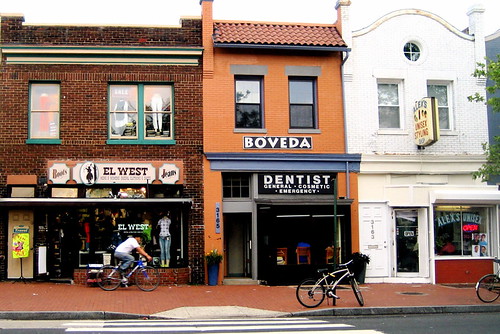
Mt. Pleasant's cheerful collection of bodegas, bars, and beauty salons along its main commercial thoroughfare cut a striking contrast to the national chains just two blocks east in Columbia Heights. Like the apartments and houses in the residential areas of Mt. Pleasant, the commercial corridor and the progression of businesses that have occupied its storefronts are part of a narrative of cultural change and population shift.

Historic Mount Pleasant (HMP), the local organization dedicated to preserving the architectural heritage of the neighborhood, recently received a grant from the Humanities Council of Washington, DC to create an in-depth study of the Mt. Pleasant commercial corridor. Working with records from the National Archives and Records Administration, the Washingtoniana Collection at the DC Public Library, the DC Recorder of Deeds, and the Historical Society of Washington, DC, HMP developed databases of historic building permits, and “chain of title” for historic commercial properties. The “chain of title” report lists past owners of many commercial properties from their construction to the present day.

1919 Baist Map of the
Commercial Corridor
The narrative, which largely covers the years between 1904 and 1938, depicts a bustling streetcar suburb in which “over one-third of the spaces had housed grocery stores; another 8 delicatessens; 4 bakers or confectioners, and 3 restaurants.” An additional 20 storefronts housed clothing-related businesses. The database reveals that during the early 20th century, the commercial corridor of Mount Pleasant focused heavily on the immediate needs of neighborhood residents, and was the basis of a self-sufficient community. When Ward 1 experienced a large influx of immigrants from Central and South America after the 1960s, the character of the neighborhood changed, but the dedication to meeting the needs of a thriving urban neighborhood did not. The grocery stores and delicatessens became bodegas and tiendas latinas, and the commercial corridor reflected the diversity and dynamism of the neighborhood.

Even a brief glance at the raw data raises powerful questions about the history of the neighborhood, and about urban development in general. The largely quantitative study is available at Historic Mount Pleasant's website and the narrative is cataloged as part of the Humanities Council's DC Digital Museum. Examine the documents and let us know what questions, themes, patterns, and ideas seem to be begging for in-depth analysis. Leave a comment on the blog or write to Jasper Collier, Curator of the DC Digital Museum at, jcollier[at]wdchumanities[dot]org.

Thursday, October 28, 2010

DC Office of the Chief of Technology Officer Digital Literacy Meeting

What Does it Mean for the Humanities?


The District of Columbia is poised to offer increased broadband internet access to underserved areas of the city. The infrastructure is largely in place, but so is the legislation that prevents the Office of the Chief Technology Officer (OCTO) from turning on the juice. At a digital literacy summit in Deanwood yesterday, the agency sought to encourage conversations between stakeholders in an effort to rollback these roadblocks and level the information technology playing field in DC. What does this mean for the humanities?

The humanities disciplines can give a voice to overlooked populations, but an idea without a medium for transmission is often extinguished before it has a chance to make a difference. Inexpensive broadband connections in underprivileged communities will allow a new segment of the population to send and receive creativity, intellect, and experience. The humanities can help people understand one another. Training Grounds Inc, a non-profit based in Southeast DC, seeks to connect economically disadvantaged young people with mentors via distance learning technology. The organization's founder Tom Brown believes that broadband technology used in this way can help people with bridge generational and socioeconomic gaps, improving the lives of youth participants and mentors alike. The humanities disciplines can help people take ownership of their history, heritage, and culture – a major goal of the Humanities Council of Washington, DC as exemplified in the DC Community Heritage Project and DC Digital Museum.

The DC Community Heritage Project, a partnership between the Humanities Council, the DC Historic Preservation Office, the DC Commission on the Arts and Humanities, provides grants to grassroots history and heritage preservation groups in the District. These small organizations have taken relatively small awards and done impressive work in the three years since the funds were first offered. Some have made professional quality documentary films, others have published neighborhood cultural guides, a few have staged moving oral history projects, but the projects rarely take the leap into the digital age. The DC Digital Museum, an evolution of the Humanities Council's Humanities Resource Center, is an effort to digitize as many of these grantee projects as possible, organize them in an online catalog, and use them to curate digital exhibitions. The ultimate goal is to allow former grantees, community historians, and others interested in DC culture to organize their own exhibitions and contribute to the collection digitally.

This ambitious project is already underway; the catalog, based on the George Mason University Center for History and New Media's Omeka program, is available at www.wdchumanities.org/hrc. The DC Digital Museum's beta exhibit is based on the life of Flaxie Pinkett, a noted pillar of the DC community and pioneering business woman who advocated for improved housing conditions and education reform.

The city currently offers WIFI hotspots at all public buildings including schools, libraries, recreation centers, and fire stations, while the mobile technology lab (pictured at left) roams the District offering free computer and internet access. OCTO's efforts to improve broadband availability in all areas of the city are absolutely vital to the success of digital humanities projects like the DC Digital Museum. Perhaps the humanities can provide some of the compelling content that will maintain interest and motivation for the city's efforts to make IT universal.

Thursday, September 23, 2010

Flaxie Pinkett: Social Entrepreneur

New Online Exhibit Explores the Life of a Washington Icon


Over the Summer, The Humanities Council of Washington, DC initiated a project  that will explore the life and legacy of one of Washington's most prominent historic figures – Flaxie Pinkett. Pinkett was an entrepreneur, mentor, and activist, and her efforts to improve the availability and condition of affordable housing in the District will not soon be forgotten.

Flaxie Pinkett's nephew Norris Dodson is leading the campaign to build a scholarship fund in her name for the Humanities Council's youth leadership program Soul of the City. Additionally, Dodson has offered the Council use of a collection of family photographs and mementos that will become part of an online exhibit honoring Pinkett's legacy.

The broader goal of the exhibit is to collect memories, quotes, and stories from the people around Washington, DC whose lives Pinkett touched. These remembrances can be posted here, in the comments section of this blog post, or they can be sent directly to the Humanities Council at jcollier@wdchumanities.org.