Showing posts with label community history. Show all posts

Tuesday, July 2, 2013

A Few Thoughts on Last Week's DC Community Heritage Project Symposium

Insightful commentary on last week's event from Humanities Council Grants and Special Projects Intern, Sneha Sharma

Washington D.C. residents don’t always have all that much in common with one another. They come from different cultures, backgrounds, and hold a diverse array of professions. Some residents have lived here their whole lives and others just moved in. Often, one of the only things these residents hold in common with one another is the history that surrounds them. Washington D.C. has a rich and extensive history that visually reveals itself through the mix of old and new architecture and the plethora of museums. In order to find a collective sense of community, residents ideally should understand this shared history. 

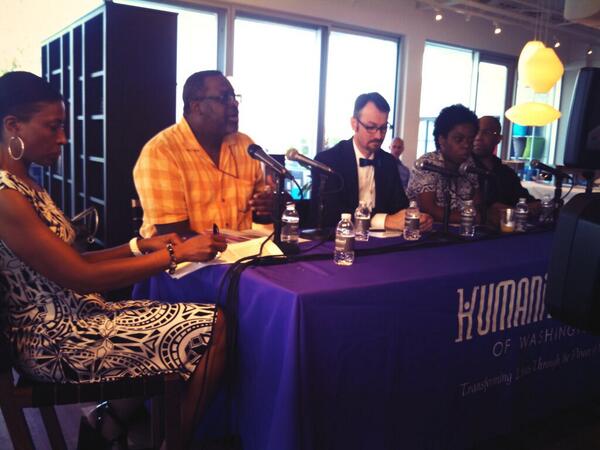
Not only did the panelists at last week's DC Community Heritage Project Symposium address these abstract ideas, they also discussed the importance of architecture and urban planning in relation to community. Throughout history, racism and rising property prices displaced residents and disrupted any shared sense of community that previously existed. In the present society, residents’ common knowledge of these past events can strengthen their understanding of the community and of each other. Since all the panelists possess strong community ties, they ably discussed how their interactions and work within the community improved when residents identified with their community’s history. Through their statements during the discussion, these panelists all reinforced the idea that a community’s history is always relevant to the present residents whether these residents have been here for five or fifty years. 

After the discussion, I realized that these speakers would never have come together if not for the city’s history that they are all so invested in. This demonstrates the strong sense of community that history can help create. The panel itself was well attended and was followed by a Q and A session where some attendees voiced their personal experiences and opinions in relation to the discussion topic.

(Sharma is a student at The University of California Riverside and is currently studying at the University of California DC Center)

Thursday, June 20, 2013

Announcing this Year's DC Community Heritage Project Grant Award Winners

$36,000 Awarded for 18 Projects Spanning Every Ward in the City

Congratulations to these 18 outstanding organizations! Each one is working to document, preserve, and share the history of Washington, DC's neighborhoods, landmarks, and culture. 

Logan Circle Community Association, “Logan Circle Heritage Trail Education Curriculum”

The Logan Circle Community Association (LCCA) will, with Garrison Elementary School, Cultural Tourism DC (CTDC), and instructional specialist Chris Magnuson, develop a curriculum outline for 4th and 5th graders that will accompany the forthcoming Logan Circle Heritage Trail. The Heritage Trail, which will be dedicated on July 13, 2013, highlights the civic and cultural history of the Logan Circle neighborhood via beautifully crafted signs that will be mounted on public property along 15 stops throughout the Logan Circle neighborhood.

Chowan Discovery Group, "The Gold Coast"

Chowan Discovery Group will produce a 15-25 minute documentary about Washington, DC's upper 16th Street, NW neighborhoods of Crestwood, Shepherd Park, Colonial Village and North Portal Estates during the period of the 1950's to the 1990's, when most of the population was made up of African-American leaders in the areas of law, education, healthcare, government administration, military and business. The film will include interviews with residents of multiple generations. 

Crestwood Citizens Association, "Crestwood History Project"

The Crestwood History Project will publish a book tracing the little-known history of a neighborhood united within consistent boundaries since its first survey in 1720. This published history, full of photos, drawings and maps, will not only provide Crestwood residents with an enhanced sense of community, it will help give the neighborhood its place in DC history alongside nearby areas that have been better documented.

Paul Laurence Dunbar High School
Paul Laurence Dunbar High School Convocation and Alumni Federation, "Dunbar High School Student Project on Dunbar Alumni Legends and Pioneers"

This exciting new project will engage students at Paul Laurence Dunbar High School in a range of educational, research and training experiences providing skill sets that will be beneficial in college and in any work environment. Students will research and identify Dunbar alumni and faculty that have made historically significant and vital contributions to the District and nation. 

Anacostia Community Outreach Center, "The Langston Terrace Dwelling Oral/Video History Project"

The Langston Terrace Dwelling Oral/Video History Project will give the Langston Dwelling Summer campers an opportunity to learn, witness and embrace the importance of the history of their community. The young people will research the history of Langston and interview, photograph and video artifacts of several residents and other stakeholders of the community to be included in the final presentation. The final presentation will include a program open to the community that will feature a showing of the finished product at the Anacostia Community Outreach Center office.

Female Union Band Society, "Mt. Zion/Female Union Band Historic Memorial Park Foundation Website Development Project"

The Foundation seeks funding to hire a web designer to design and launch a website for the Foundation. The website will be a valuable tool for the Female Union Band Society as they work to increase visibility of the Mt. Zion and Female Union Band cemeteries and will also serve as  an effective means of distributing historical information to researchers, tourists, and the community. 

Neighborhood Farm Initiative, "DC Garden Oral History Project"

This oral history project will record interviews with older Washingtonians who have spent significant portions of their lives growing their own food and have participated in Washington's local food economy and culture. By conducting interviews with a diverse group of individuals across the District, they will document not only each gardener's individual story but also the culture, traditions, and practices of food-growers in this city. Interview questions will be geared towards capturing the ways that food has connected people in their neighborhoods and communities at different points in history. 

Deanwood Heights Main Streets, "Master Builders of Deanwood"

Deanwood Heights Main Streets (DHMS) will host a Saturday seminar and screening of Michelle Jones' latest film about African-American architects and their work in DC. The seminar will focus primarily on examining the stories of the architects who lived and worked in Deanwood. 

African American Holiday Association, "African American Pioneer Muslimahs in Washington, DC (Part Two)"

This project is Part Two of the first documentary completed in 2011 through a grant from the Humanities Council of Washington, DC.The producer will conduct another set of interviews with four or five elderly African American Muslim women (Muslimahs) who were not included in the first film. The project's goal is to tell the history of these "sisters" in their 80's and 90's, including the challenges they faced as they converted to a religion and way of life that seemed "foreign" to many. Some of these Muslimahs helped to build DC's only "temple," now the masjid, from the ground up.

Universal Negro Improvement Association Historical Society, Inc., "The Impact of Marcus Garvey and the UNIA in Washington DC"

This three day project will feature an exhibit, discussion, and tours on impact of Marcus Garvey in Washington, DC. All of the programs will be held at the Americas Islamic Heritage Museum in Historic Anacostia.

Black Student Fund, "Remembering the Dream Makers of Black Student Fund"

Black Student Fund (BSF) scholars will archive, research, and document the history of BSF. The research will focus on the organization's leadership and its impact on the DC independent school community. As part of the project, BSF will produce a video on archival and historical research techniques to guide the young scholars in their work. The project will be conducted in preparation for the organization's 50th anniversary in 2014.

Henson Arts in Learning, "Citizens We"

The Citizens We Project is a photographic portrait of the people in the neighborhoods of Adams Morgan, Mt. Pleasant, and Columbia Heights in Washington, DC conducted in partnership with the Shrine of the Sacred Hear Dinner Program. The project will consist of an exhibition of thirty 17 x 25 inch black & white prints of clients from the Shrine of the Sacred Heart Dinner Program, and an online publication about the Dinner Program and the challenges of immigration in contemporary American society. The publication will be available online for free and sold as a soft cover book.

ANC7B, "We are Fairfax Village"

“We are Fairfax Village” is a project working to document the extensive history of the Fairfax Village neighborhood. The mission is to: 1) pursue and value the oral histories of past and current residents of Fairfax Village, 2) perform historical research of various resources related to Fairfax Village, 3) work collaboratively to author, illustrate, and share documents in accessible and user-friendly ways. 

WSC Avant Bard, "Kendall Green and the National College for the Deaf"

WSC Avant Bard will develop a play that explores the history of deaf culture and the history of Kendall Green. The play will be researched by professional scholars and written to convey the history of this often ignored piece of DC's historical narratives to a diverse audience.

All African People's Development and Empowerment Project, "Marcus Garvey Enrichment School Documentary Project"

The Marcus Garvey Enrichment Documentary Project will work with African American youth living in the Barry Farms community of Washington D.C. Youth from the ages of 13-18 will produce a documentary about the historical Barry Farms community, its current social history, and the thriving culture that highlights the positive culture of Barry Farms, but also the historiography of Southeast, Washington D.C. The initial phase of this project seeks funding for research and development of a proposed documentary that audio-visually depict the rich, but under-represented African American youth’s perspective on the current issues of Barry Farms and the broader African American Washington, D.C. community. 

Military Road School Preservation Trust, "Oral History of the Military Road School Alumni before 1954"

As part of the Sesquicentennial observance of the Military Road School, a video of oral histories provided by alumni who lived in the Brightwood community as well as nearby Maryland and attended the School from the 1930's to 1954 will be developed for the purpose of corroborating the educational legacy for which it was well known until closing as a D.C. public school in 1954.
The oral history collection will be accessible to the general public online as a resource that will enable students, teachers, and a wide range of ordinary citizens to witness the academic, social and cultural aspects of what school life was like for preceding generations of African-Americans.

Community Resources Incorporated, "A Loud Silence: A Visual Code on the Underground Railroad"

The Song Yet Sung, by James McBride is the most lyrical, profound, and mystical rendition of the enslavement experience because it centers around, and depicts the use and power of “The Code”, a complex system of signs, symbols, and markers as well as the individuals who connected them to one another and who created a path for enslaved people seeking freedom.This project will research the Underground Railroad in DC, obtain maps of the topography and terrain at the time, create mixed media work depicting the markers, codes, symbols and signs uncovered, and tell the story of their composition, creation, use and meaning.

Rehoboth Baptist Church Historical Committee, "Documenting History of Rehoboth Baptist Church (150 Years)"

Rehoboth Baptist Church will gather, organize, catalog, and archive materials to prepare a comprehensive book on the history and life of Rehoboth Baptist Church (1864-2014). The Rehoboth Baptist Church was founded by former slaves and is one of the oldest Black Baptist Churches in the city.

Join us in December when each of these projects will be presented at the DC Community Heritage Project Showcase!

Thursday, November 8, 2012

Kent Boese Believes Historic Preservation Can Promote Respect and Progress Within a Community

Recent DC Community Heritage Project Grant Recipient Discusses Community History and his Forthcoming Park View Walking Tour

By Priya Dadlani


Kent Boese is a DC Community Heritage Project grantee, who created the Park View Walking Tour project and gave the Park View neighborhood a prominent voice in the DC community. Boese moved to the neighborhood in 2007, not knowing much about the community, but after getting to know his neighbors and conducting some research, he found out that this small neighborhood is very unique and holds interesting stories unknown to most of the District. Boese grew up in Harvard, Illinois,a small town of about 5,000 residents. Boese says, “I've discovered in many ways each neighborhood within D.C. operates like a small town. I guess that's why I fell in love with my neighborhood and why I am an effective advocate for it.” Like small towns, communities in the District function better when people work together. Helping neighbors, calling officials and assisting the community are common actions for Boese and others living in communities like Park View.

Boese quickly realized that other local blogs often distorted Park View or fostered their own bias about it. To properly represent the neighborhood, Boese created a blog where he shares information about Park View to anyone who wants to learn more about the community. “I wanted the community to have an equally strong voice as surrounding neighborhoods. I also wanted to create a place where local news and articles on history, development, crime, etc. could be shared and foster discussion within the neighborhood,” says Boese.

Boese’s blog, Park View, D.C., includes reports on the “collective memories and experiences of DC citizens”. Boese believes these details are important because Park View, with the rest of DC, is going through many changes. But the Park View Boese fell in love with is the one that he moved to, not “some mythical future neighborhood”. So for him, it is important to preserve the deeply rooted history of the community and its citizens and make these stories available to newer residents so they will be able to more thoroughly understand what Park View is and make stronger connections to the history of the community. Boese says that, “one of the greatest assets of the neighborhood is the long-established residents. It is in the community’s best interest for the contributions of all previous generations to be known if we are to value and respect each other and continue to move forward as one community.”

The love Boese has for DC comes from a very rich history and to him the District is interesting because it has both “deep roots” and a “transient population”. It also has both a national and a local presence. After many years of relative stability, the city is undergoing a lot of growth and demographic changes. “How we as Washingtonians respond to these changes - preserve, document, and make our history accessible - successfully fight and minimize displacement - and move together as a city will determine our worth to the country and the world,” says Boese. DC has great potential for a better future , but it can only be realized if newer residents and older residents are able to work together and learn more about one another’s history . Boese believes that preserving the history of the city and passing it on to new generations will help District citizens in achieving this goal.

Kent Boese has done something great for DC by giving Park View a voice just as loud as those of its’ neighboring communities. The walking tour project Boese is working on is nearing completion, and a draft was recently sent to the printer. The next step is to distribute all the brochures throughout the District and get the word out about where copies can be found. The Humanities Council is excited about Boese’s walking tour, and we hope the Park View community will be too.

Monday, May 21, 2012

Zion Baptist Church Oral History Project

Narrators Reveal a Southwest Centered On Neighborhood Churches, Schools, and Businesses

During the 1930s and 40s, despite the fact that Washington, DC's population was well on it's way to reaching 700,000 people, the city's Southwest quadrant retained the appearance and feel of a small town. The narrators of Zion Baptist Church's "Spoken Memories" oral history project recall this slow-paced, civic-minded community from the shadows of the hulking concrete highrises that now line Maryland and Virginia Avenues. 

One interviewee remembered, "I missed the church in Southwest because we had strong family ties. All of us had friends and family members at the different churches. My grandfather and one uncle were members of Mt. Moriah Baptist Church. I had cousins who went to Friendship, and friends who attended the Catholic Church, St Vincent De Paul. Southwest was a community because its residents were always together. We all went to Randall Junior High, and we socialized in the neighborhood together. Zion always had church sponsored summer trips to the beach for us. We went to Carr's Beach, Sparrows Beach and a beach in New Jersey. We went on hay rides to the outskirts of Maryland, and we had summer-long Vacation Bible School. Southwest was a meeting place." 

Other narrators also speak of the close link between Southwest's religious community. It was a neighborhood of many churches, and many different religions, but all were bound together through service to their congregants. Long term social bonds, and a general sense of steadiness seem to have contributed to the narrator's memories of Southwest as a tight-knit neighborhood. "I don't see Zion as the family and community church that we had in the past," observed one narrator. "Now, new members join Zion and leave before you can get to know them. In earlier times, Zion had more stability and folks got to know each other. We were a true family and we looked out for one another." 

But old Southwest's character was not to be found solely in it's thriving religious life, but also in the school system and it's ever-observant teachers. One narrator remembered, "Mrs. Peterson was my Principal at Randall Junior High School, so seeing her at church was like seeing her at school. Many of our teachers were also members of Zion. There was Mr. Herbert, who taught at Randall and was a member of Zion. The teachers knew the 153 families of Southwest, so nobody got away with bad behavior. They always made us aware of our conduct." Some years later that same Mrs. Peterson became Assistant Superintendent of the DC Public School system, but her students and neighbors still remembered her fondly for all she had done in Southwest. "She knew the Southwest families," recalled one narrator, "and often assisted them in their struggles."

Schulman's Market at N and Union Streets, SW
Image Courtesy: Library of Congress
Though Southwest is currently experiencing a resurgence in business activity, the urban renewal of the 1950s transformed many of the commercial corridors into residential streets, and many of the storefronts into government office buildings. But in the 1930s and 40s, a thriving small business community contributed to the cohesiveness of the neighborhood. One narrator remembers, "Many members had businesses located in the Southwest. Everything we needed was in our community. We had restaurants, cleaners, barber shops and stores." Another interviewee is more specific; " A lot of our members had businesses on Third Street, F Street, and Fourth Street... ... Someone had a shoe shop. Mr. James Brown had a print shop and used to do all of Zion's bulletins. The Barnes & Matthews Funeral Home was located on Fourth Street. I also remember the drug store, Campbell's Funeral Home, John T. Rhines Funeral Home, Bruce Wahl's Night Club, and a restaurant. Everything we need was within the Southwest community."

Zion Baptist Church's oral history project is valuable to Washington, DC not just because it preserves the history of a venerable religious institution, but because the words of its narrators breathe life into interpretations of archival records. The housing stock, church buildings, storefronts, an d school buildings of neighborhoods such as Georgetown, Capitol Hill, and Shaw serve as visible reminders of what those neighborhoods once were. But in Southwest, where there are only shadows and glimpses of the neighborhood's historical city-scape, we must try to rebuild it in our minds through the memories of those who were there. The next post in this series will examine Zion, and its congregants' transition from Southwest to it's current home on Blagden Avenue, NW.

To view the edited transcript of the Zion Baptist Church "Spoken Memories" Oral History project, visit the Humanities Council's DC Digital Museum. 

Thursday, February 2, 2012

Today in the Humanities... Wikification; Neighborhood Names; and "The Father of Black History"

Kick off Black History Month With a Healthy Dose of Humanities From Around DC and Beyond!

Like most scholars, I was skeptical about Wikipedia when Jimmy Wales first launched the site back in 2001. The notion that unvetted volunteers cooperatively contributing to an online encyclopedia might produce a reference work of any real value seemed at best dubious—and, more likely, laughably absurd. Surely it would be riddled with errors. Surely its coverage would be ridiculously patchy. Surely it would lack the breadth, depth, and nuance of more traditional reference works like the venerable Encyclopedia Britannica.


To some, Anacostia can also include a cluster of surrounding neighborhoods, including Fairlawn to the northeast and Barry Farm -- sometimes called Barry Farms -- to the southwest. To others, Anacostia is just, well, Anacostia, the neighborhood with the big chair.


Known as the “Father of Black History,” Woodson (1875-1950) was the son of former slaves, and understood how important gaining a proper education is when striving to secure and make the most out of one’s divine right of freedom. Although he did not begin his formal education until he was 20 years old, his dedication to study enabled him to earn a high school diploma in West Virginia and bachelor and master’s degrees from th University of Chicago in just a few years. In 1912, Woodson became the second African American to earn a PhD at Harvard University.


To start the workshop off with a shared understanding of the DPLA[Digital Public Library of America] initiative, Maura Marx, Director of the DPLA Secretariat, gave a brief presentation covering the events and ideas informing the development of the DPLA. The project was born from a relatively straightfoward need: to digitize materials, both historical and current, and make them widely available to the public. In 2010, The Alfred P. Sloan Foundation promised to offer funding to any group that could work toward that goal, and the DPLA arose shortly thereafter as a sort of "network operation center" to articulate and plan such a project.


On the second night of the Slam!, the poets of Beers Elementary School put on an impassioned performance with lines such as "We'll eliminate all distractions and change our ashes"; "Go to school, you can still be cool"; and "We can all make change for the better."


Dr. Ira Berlin, author and professor of history at the University of Maryland, will discuss the connections between slavery and the building of the university.


Col. Benjamin O. Davis, Jr.
In reality, the Tuskegee Airmen placed a premium on discipline, precision, order and military bearing. After all, they were under the command of Benjamin O. Davis Jr., a black man from the District, whose rank as an Air Force general and whose education — 35th out of 276 at West Point, class of 1936 — was awe inspiring.


As a middle or high school student you have had plenty of experiences to shape your ideas and perspectives about cultural and global issues in our city, from your travels, or where you come from.  Wouldn’t it be great if other students could learn what you know? With One World Education’s Culture & Global Issues Writing Program you have a chance to become a published writer – whose writing will be read by thousands of other students.


Monday, January 30, 2012

Humanitini Comes to Axum Restaurant and Bar!

Happy Hour Conversations On Today's Hot Topics

Our signature think-and-drink event is back starting Tuesday, February 21st and then every Tuesday after until March 13. The Humanitini is a relaxed discussion between a panel of experts and a happy hour audience on topics of timely interest or importance. Topics will include:
The final two programs will take place at Axum Restaurant and Bar at 1934 9th Street, NW!
  • Caps, Nats, Wiz, and 'Skins: Finding Community Identity Through Sports - We'll take a humanities spin on local sports fandom. Our panelists and the audience will explore the District's unique sports identity. Can a city with a large transient population attract dedicated home-team supporters? Confirmed panelists include Brian Tinsman from The Redskins Blog, Kyle S. Yeldell from National Newspaper Publishers Association Foundation, Howard University Soccer Head Coach, Michael Lawrence, American football tight end Leonard Stephens, and Edwin Henderson from the Tinner Hill Heritage Foundation. The panel will be moderated by Amy Saidman of SpeakeasyDC. This Humanitini will also feature Demont “Peekaso” Pinder, local artist well known as being the art director for JIVE recording artist Raheem DeVaughn. He will paint a sports themed piece during the panel discussion and it will be auctioned off at the end of the program.
  • Occupy DC: What is the Price of Freedom? - This program will take a street-level look at the Occupy DC protest, examining its origins and goals as well as the effect it has had on local businesses and city agencies. Confirmed panelists include community activist and lobbyist Erik Jones, and Sinclair Skinner, Legba Carrefour, and Megan Brett from Occupy DC Media team. This panel will be moderated by Andy Shallal, founder of Busboys and Poets.  
  The events are completely free and open to the public (donations accepted).


View Larger Map

Thursday, January 12, 2012

The How and Why of Community History in Shaw

Footage in DC Digital Museum Archive Shows a Community Determined to Preserve its Heritage and Culture

The collection of the DC Digital Museum is diverse because it essentially reflects the Humanities Council's grantmaking activities since the organization was founded in 1980. Combing through the archive, has been a great way to get to know the city on a very human level. 

Sometimes researching and archiving a raw collection can be challenging and surprising at the same time. Earlier this week, we unearthed a couple of VHS cassettes labeled "Shaw Neighborhood History: The Whitelaw Hotel." A search in the old database brought up a record for these tapes that indicated they were copies of a documentary film on the Whitelaw and its relatively recent preservation as an apartment building. It seemed like a great topic for a documentary, and we were eager to digitize it, determine its creators and provenance, and make it available through the DC Digital Museum. 

We were disappointed at first to see that the tapes contained no such documentary. The footage was shot at the then newly renovated Whitelaw, but it was of a planning meeting, led by historians Kathy Smith and Marya McQuirter, involving residents and former residents of Shaw and the greater U Street Neighborhood. The audience had been brought together to discuss a planned history exhibit at what was to become the Thurgood Marshall Center for Heritage and Service; they were discussing how to best represent their memories as a historical narrative .

The footage is not just a record of the collective memories of Shaw community members, it is a fascinating text that shows how people seek to use the histories, preserved through memory, architecture, tradition, and human relationships, to actively pursue social improvement in the places that mean the most to them. 

The clip below represents only about one fifth of the conversation that occurred that evening April 10, 1996 at the Whitelaw. Please leave a comment if you or anyone you know participated in the planning meeting. What role does history have in Washington, DC's neighborhoods today? Is it different than it was 15 years ago?


The museum exhibit based, in part, on this community conversation is housed in the Thurgood Marshall Center for Heritage and Service at 1816 12th St, NW and is open to visitors during the day. Call (202) 462-8314 for exact hours.

The conversation also provided Smith and McQuirter valuable information as they compiled a guide to Shaw's Historical Resources, available in the DC Public Library's Washingtoniana Division.

Wednesday, December 21, 2011

History and Community in LeDroit Park

Can Local History Projects Mend Collective Memory?

It's hard to imagine that densely packed Ward 1, with its rows of federal style townhomes and gleaming new luxury condos, was once the target of developers looking to establish subdivided and suburban-style gated communities, but in 1873, LeDroit Park was conceived as just that. Filmmaker Ronald Smokey Stevens recently completed a documentary as part of the DC Community Heritage Project that surveys the history of the neighborhood from its exclusive beginnings, through its illustrious decades as the locus for black culture in Washington (and perhaps the United States), to its current challenges and successes. The film, Preserving LeDroit Park: an historic DC Community, is available in full as part of the Humanities Council's DC Digital Museum, but it can also be purchased at http://www.preservingledroitpark.com.

Stevens' film exemplifies the value of historic preservation and public history. It not only tells the story of LeDroit Park, but it tells the story of a man who's regular rounds through the neighborhood carried him past the Robert and Mary Church Terrell House, and how these encounters with the past inspired and empowered him to find out more.

Mary Church Terrell, Stevens' tells his viewers, began fighting for Civil Rights using civil disobedience tactics long before Rosa Parks, Martin Luther King, Jr., or the Freedom Riders. In 1950 Terrell and a group of activists sought to test the District of Columbia's anti-segregation laws by entering a de facto white-only restaurant. When they were refused service, they filed a lawsuit which, by 1953, led DC courts to rule segregation in eating places unconstitutional. Though many longtime residents of LeDroit Park and Washington, DC likely know of Terrell and her groundbreaking work, her story may be news to families who have recently made the neighborhood their home. By helping to popularize the story of Terrell as well as those of Anna J. Cooper, Walter E. Washington, Reverend Jesse Jackson, Paul Lawrence Dunbar, Duke Ellington, and the other notable residents of LeDroit Park, Stevens can help build a sense of community pride and appreciation of a common past.

Photographer David Corry, interviewed for the film, believes that creating this sense of community will be an ongoing challenge for LeDroit Park, but one that can be overcome. The perceived lack of a sense of community caused by gentrification and demographic shifts can be remedied by public history projects like Stevens' film as personal connections to place and time are developed for newcomers, and rebuilt among long-term residents.

The film is produced well, making use of Stevens' oratory skills, authoritative historical research, illustrative photographs, and stock video footage. It is brief, but informative, and well worth the 17 minutes for anyone interested in Washington, DC history.

More information on the notable residents of LeDroit Park can be found in Kim Roberts' online exhibition Wide Enough for Our Ambition.

Tuesday, November 1, 2011

38th DC Historical Studies Conference Kicks Off this Weekend

Annual Letitia Woods Brown Lecture on the Civil War in Washington

The 38th Annual DC Historical Studies Conference kicks off this weekend with the Letitia Woods Brown Lecture, and a fascinating plenary discussion about a Digital History of the Civil War in Washington, DC. The Brown lecture is titled "Lincoln's Citadel: The Civil War in Washington, DC," and will be delivered by Professor Kenneth J. Winkle of the University of Nebraska-Lincoln. The Civil War is not the only topic of discussion during the 150th Anniversary of the conflict, but it certainly is a major theme throughout the two-day conference schedule. 

The sesquicentennial of the Metropolitan Police Department will be highlighted in a panel discussion featuring department historian Lieutenant Nicholas T. Breul, with Martin Murray, and Sandra Schmidt and moderated by Bill Brown. A session on political collections in DC's archives will be moderated by Yvonne Carrigan, Head of Special Collections and Archives at George Mason University's Fenwick Library. The panel will include librarians and archivists from other area Universities as well as the DC Public Library Washingtoniana Division. Professionally guided history tours will be offered of Lafayette Square and major sites of Prohibition-Era Washington. 

Recent recipients of the Humanities Council and the DC Historic Preservation Office's DC Community Heritage Project Grant will form a panel exploring neighborhood history. Another DCCHP grantee, John Eaton Elementary School, will demonstrate their student-produced, web-based history project. Their session is rounded out by Lucinda Janke, Kesh Ladduwahetty, who produced a Humanities Council funded online exhibit on the Franklin School last year, and Kimberly Springle, Director of the Sumner School Museum and Archives and Humanities Council Board member. It is great to see so much of the great work produced by these dedicated local historians and scholars represented at the conference.

This overview by no means covers all of the sessions offered at this year's conference. With so many great speakers and new ideas, there is bound to be something of interest to just about anyone. Check the conference's blog for more details on the schedule and how to register for sessions.

Thursday, October 13, 2011

DC Community Heritage Project at the 38th Annual DC Historic Studies Conference

Patricia Hallman,Javier Barker, and Graylin Presbury to Represent 3 Past Grantee Organizations

The Cover Page from the
Fairlawn Citizens Association's
DCCHP Publication
This year's DC Historical Studies Conference will feature a panel discussion with three of our past DC Community Heritage Project Grantees. On Saturday, November 5, from 3:15-5PM, representatives from the Capitol View Civic Association, the Eastland Gardens Flower Club, and the Fairlawn Citizens Association will discuss their projects, and provide guidance to others who may wish to replicate their success. 

The DC Community Heritage Project is a partnership between the Humanities Council, the DC Historic Preservation Office, and the DC Commission on the Arts and Humanities. The program is designed to provide DC community organizations with the tools and funding necessary to document and preserve the history of their neighborhoods. 

The discussion will be moderated by Patsy Fletcher of the DC Historic Preservation Office. Check out the conference website for more information.

Monday, September 12, 2011

DC Humanities Book Reviews: Growing Up in Washington, D.C.: An Oral History

After an Admittedly Long Hiatus... The Book Review Series Continues

The following is Bridget Sullivan's second book review for Human Ties. Sullivan will enter the second year of in the Public History Master's Degree Program at American University this Fall. She has worked extensively this Summer as a liaison to the Humanities Council's DC Community Heritage Project grantees, and on other projects related to District history and culture.

Connors, Jill, ed. Growing Up in Washington, D.C.: An Oral History. The Historical Society of Washington, D.C. (Charleston: Arcadia, 2001) 158 pgs.

This work is the end product of an oral history project completed by the Historical Society of Washington, D.C. It is a compilation of quotes taken from the wide spectrum of oral histories collected. The body of interviews is comprised of residents of all DC neighborhoods, and a wide range of ages. This variety creates a picture of a vibrant community, and reflects the changes the DC community has experienced over the last few decades.

The Historical Society grouped quotes around seven major facets of everyday life including, holidays, working in the city, school, and the creation of communities. These categories allow the reader to truly explore many of the unique aspects and historical traditions of the neighborhoods of Washington, D.C. In addition to the breadth of knowledge available in this work, the Historical Society has presented it in an easily readable and simple format.

The strength of this project comes from the gems of knowledge and history within the interviews conducted, which allow these resources to speak for themselves. There is no attempt to force a traditional narrative. Instead, quotations from the oral histories are organized and presented in a way that gives the reader a strong sense of the environment in DC during any given period or event. An introduction to the oral history participants is another warm touch of this work.

The book is designed not only to give a sense of the DC community, but also to welcome the reader into that community. It presents an important, and often overlooked, side of the history of Washington, D.C. Washington as a community as well as Washington as our nation’s capital. Overall, I would recommend this book to anyone interested in the local history of Washington, D.C.

Saturday, August 6, 2011

In the Pipeline: Political Activism in Columbia Heights

HCWDC Grantee Bell Clement Discusses Her Current Project

In this article, Clement provides context for her project, and describes her research plan. She hopes to provide regular updates as the project progresses.

The 1960s were a period of transition for the United States.  The nation shifted gears as the effects of a generation of prosperity and global power made themselves felt in structural changes to key institutions.  In this restless, affluent nation, political activists, in office or on the street, worked to open the next chapter of the American story.  Building on decades of advocacy and organizing, civil rights campaigns gained momentum and national attention.  In the White House, the Kennedy and Johnson administrations responded to the issues raised by civil rights leaders, and also proclaimed unconditional war on poverty and began to look carefully at conditions in the nation’s cities. 

Turmoil in the District of Columbia exemplified the times.  Inner city neighborhoods were reeling from the impact of a massive federal “urban renewal” campaign which, starting in the late 1950s,displaced 25,000 residents from the city’s Southwest quadrant.  D.C. Public Schools had desegregated immediately on rendering of the Supreme Court’s 1954 opinion in Bolling vs. Sharpe, but citizens’ battles over the implications of that order continued, culminating in the  Hanson vs. Hobson (1968) challenge to academic tracking.  Locals battled Congressional determination to ram national highway system feeders through old residential neighborhoods – “white men’s roads through black men’s homes”.  The ancient campaign for home rule reached its zenith with LBJ’s 1965 full court press for legislation and, in defeat, his creation of an appointed Mayor and council government as an interim step toward residents’ goal of autonomy.

In the midst of this tumult, Columbia Heights was distinguished by the energy of its organizing and advocacy campaigns. Centered on Fourteenth Street, a key retail corridor and the route of one of the first streetcar lines into the neighborhoods from the downtown; bordered on the west by the mansions and consulates of Sixteenth Street, the “Avenue of the Presidents,” and on the east by Howard University, Columbia Heights had always been a hub of commercial and social activity.  During the 1950s and early 1960s, the neighborhood experienced rapid transition as black householders took over from white owners, a result of the lifting of restrictive covenants, urban renewal displacements, and school desegregation in D.C., as well as more general economic trends.  

When the national political conversation and federal policymakers turned attention to poverty, race inequities, and urban conditions in the mid-1960s, Columbia Heights found itself at the center of implementation action.   The Cardozo Heights Association for Neighborhood Growth and Enrichment, Inc. was formed as a subsidiary of the city’s United Planning Organization to implement the Great Society’s 1964 War on Poverty programming in Columbia Heights.  CHANGE became a central actor in District-wide battles over the shape of program implementation – and allocation of federal funding – over the next few years.  The creation of the Department of Housing and Urban Development in 1965 and its 1966 Model Cities agenda reverberated in the neighborhood as local congregations stepped up to sponsor affordable housing developments on Fourteenth and Sixteenth Streets.  In the wake of the violence of April 1968,  area residents formed planning and development organizations such as Central Cardozo Concerned Citizens and the Columbia Heights Citizens Association, and claimed the right to direct the neighborhood’s rebuilding. 

Project Context:   This project will use oral history interviews and supporting research to document this phase of Columbia Heights’ political evolution.  This segment of research is built on the results of an inventory of Columbia Heights community history resources, including both witnesses and archival resources, completed with support from the Humanities Council during Summer 2009.  Both this and the earlier project are elements of my dissertation research at George Washington University’s Department of History.  The dissertation (working title:  “Measuring Liberalism:  ‘Creative Federalism’, Empowered Citizens, and the Great Society City”; anticipated completion 2012) explores the interaction among federal policymakers, community activists,and the events and ideologies of the decade, in reshaping American concepts of the city, citizenship, and federalism. It is my intention to publish the dissertation in book form.

Monday, June 20, 2011

DC Community Heritage Project Symposium 2011

7th Annual Symposium to Highlight the Work of Former Grantees and Introduce New Digital History Techniques


The Humanities Council of Washington DC's annual Summer DC Community Heritage Project Symposium will be held Tuesday, June 28, from 6-8:30PM. The event will take place at the Deanwood Recreation Center and Library just across the street from the Deanwood Metro Station. This year's symposium is all about “making connections.” Each of the three sessions will explore opportunities for local history buffs to connect with each other and connect with the past.

The first session will introduce the local cemetery as an historical text. Conspicuous on the city-scape, yet secretive with their stories, cemeteries are often overlooked as a community history resources. Anne Brockett of the DC Historic Preservation Office and Tyrone General of the Historic Woodlawn Cemetery Perpetual Care Foundation will discuss how cemeteries can be coaxed into revealing the hidden heritage of a neighborhood, and the unknown stories of the deceased.

The second session will demonstrate a project that seeks to identify “neighborhood griots.” A griot is a person whose memory serves as a repository for a community's stories. Nearly every neighborhood has at least a few people who can draw on historical information passed down from generations, to enlighten, enrich, and educate those willing to listen. Historian Carrie Thornhill will discuss her efforts to identify neighborhood griots, and how her project can be replicated in other communities.

The third session will showcase software designed to help historians research, as well as organize and disseminate their findings. Sharon Leon of the George Mason University Center for History and New Media will discuss the growing field of digital history and will demonstrate some of the Center's valuable tools.

RSVP today for this FREE opportunity to learn how you can make connections with unorthodox historical texts, with others interested in community history, and with the living past! Register by visiting http://dcchpsymposium2011.eventbrite.com/, calling 202-387-8391, or emailing programs@wdchumanities.org.

Thursday, May 5, 2011

New DCCHP Cycle Set to Begin Soon

DC Community Heritage Project Grant Proposals are Due Tomorrow

The deadline to apply for the Humanities Council's DC Community Heritage Project grant for 2011 is tomorrow at 5pm, so we will soon have an outstanding new group of grantees dedicated to preserving those aspects of DC history and culture most important to them. Last year we received some wonderful final projects about neighborhoods and landmarks across the city. A group from Congress Heights produced a historic survey of their neighborhood and published it for a popular audience, another organization produced a virtual exhibit on the historic Franklin School, and Tendani Mpulubusi expanded his outstanding documentary on Barry Farm and Hillsdale.

The 2011 awards will be decided in June, and projects will take place throughout the Summer and Fall. The Humanities Council will be in frequent contact with grantee organizations, and updates will be posted regularly here on Human Ties. The DCCHP grant cycle culminates with a grantee showcase in December where organizations have the opportunity to display their projects for the public. 

The DCCHP isn't just about grants, however; the Humanities Council and its partners offer regular symposia designed to strengthen community historians and preservationists' skills and put them in contact with scholars and other experts who can help them realize their visions and tell their stories. Last Summer, the DCCHP Symposium offered participants instruction on researching commercial and residential lots in DC, creating cell phone tours, and conducting church histories. In previous years, the DCCHP symposia have focused on topics such as fundraising and creating neighborhood walking tours. Footage from those events can be viewed below and on the Humanities Council's Youtube channel, HCTV.

The Future of Fundraising

Creating a Walking Tour

The Humanities Council is planning another symposium this Summer. Leave a comment, and give us topic suggestions. We do our best to find experts knowledgeable on the topics garnering the most interest.

Monday, April 11, 2011

Celebrate Emancipation Day in DC

Pick Up a Guide, Watch the Documentary, and Check Out an Event

On April 16, 1862, Abraham Lincoln signed the Compensated Emancipation Act which abolished slavery in the District of Columbia. The legislation compensated slave owners for the freedom of approximately 3,100 people, and many refugees swelled the District population as news of the law reached the countryside. Initially, Washingtonians routinely commemorated the occasion with great fervor, but the annual celebrations lost their popularity following the Reconstruction period, and did not see a significant revival until the early 2000s. Today, the District Government, organizations like the Humanities Council, and community leaders collaborate with District residents to, once again, make this holiday an important Spring event. This year, the DC Office of Public Records, in collaboration with a host of partner organizations, has created an impressive schedule of forums, performances, screenings, and ceremonial remembrances. Click here to view the full schedule and participate in the celebration!

Several years ago, the Humanities Council worked with the DC Office of Public Records to produce a booklet called “Ending Slavery in the Nation's Capital.” The handy publication is a must-have resources for those interested in Washington, DC's African American history, and unique path to emancipation. The booklet is available for download as a PDF on the District Government's website and is part of the DC Digital Museum. Print a copy of the pocket sized guide and use it as a reference as you make your way around the celebration sites this week.

The Humanities Council also collaborated with the DC Office of Cable Television to produce an outstanding documentary which examines slave life, emancipation, and the disastrous return of oppression following the Reconstruction Period. This film is also part of the DC Digital Museum Collection and can be viewed on HCTV, the Humanities Council's Youtube Channel. Additionally, the Frederick Douglass National Historic Site will screen the film all day on April 16th as part of DC's Emancipation Day celebration.


As the Civil War ravaged the region surrounding the National Capital, many slaves took the opportunity to self-emancipate. In areas controlled by the Union Army, these individuals were eventually dubbed “contrabands of war” and received some measure of protection from slave catchers and bounty hunters, but following a fast marching military force was unsustainable for many families, and as news of DC's Compensated Emancipation Act spread, more and more freed people settled within the confines of the District. These refugees established several “contraband camps” throughout the city; informally at first, but after the creation of the Freedman's Bureau, the Federal Government began registering the inhabitants of these villages within the city, creating lists such as this one held in the Alexandria, Virginia Library Special Collection.
Camp Barker Resident List Courtesy Alexandria Library Special Collections

Camp Barker was located on what is now Logan Circle in Washington, DC. Though the physical remnants of the temporary camps have long-since disappeared, their existence in the District has contributed to a persistent sense of community and pride.

Leave a comment and let us know how you are celebrating Emancipation Day in DC!