Showing posts with label Historic Preservation. Show all posts

Tuesday, July 2, 2013

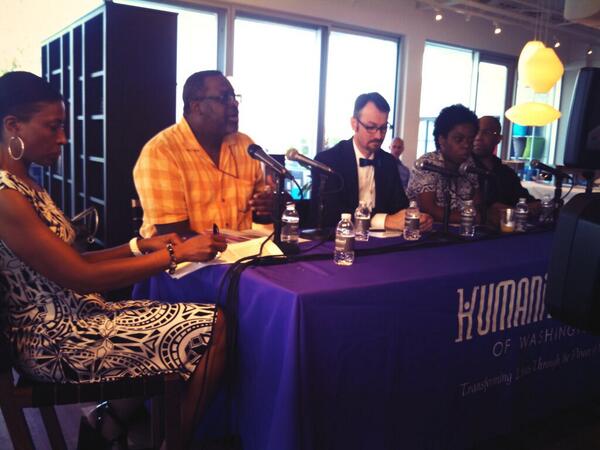
A Few Thoughts on Last Week's DC Community Heritage Project Symposium

Insightful commentary on last week's event from Humanities Council Grants and Special Projects Intern, Sneha Sharma

Washington D.C. residents don’t always have all that much in common with one another. They come from different cultures, backgrounds, and hold a diverse array of professions. Some residents have lived here their whole lives and others just moved in. Often, one of the only things these residents hold in common with one another is the history that surrounds them. Washington D.C. has a rich and extensive history that visually reveals itself through the mix of old and new architecture and the plethora of museums. In order to find a collective sense of community, residents ideally should understand this shared history. 

Not only did the panelists at last week's DC Community Heritage Project Symposium address these abstract ideas, they also discussed the importance of architecture and urban planning in relation to community. Throughout history, racism and rising property prices displaced residents and disrupted any shared sense of community that previously existed. In the present society, residents’ common knowledge of these past events can strengthen their understanding of the community and of each other. Since all the panelists possess strong community ties, they ably discussed how their interactions and work within the community improved when residents identified with their community’s history. Through their statements during the discussion, these panelists all reinforced the idea that a community’s history is always relevant to the present residents whether these residents have been here for five or fifty years. 

After the discussion, I realized that these speakers would never have come together if not for the city’s history that they are all so invested in. This demonstrates the strong sense of community that history can help create. The panel itself was well attended and was followed by a Q and A session where some attendees voiced their personal experiences and opinions in relation to the discussion topic.

(Sharma is a student at The University of California Riverside and is currently studying at the University of California DC Center)

Thursday, June 20, 2013

Announcing this Year's DC Community Heritage Project Grant Award Winners

$36,000 Awarded for 18 Projects Spanning Every Ward in the City

Congratulations to these 18 outstanding organizations! Each one is working to document, preserve, and share the history of Washington, DC's neighborhoods, landmarks, and culture. 

Logan Circle Community Association, “Logan Circle Heritage Trail Education Curriculum”

The Logan Circle Community Association (LCCA) will, with Garrison Elementary School, Cultural Tourism DC (CTDC), and instructional specialist Chris Magnuson, develop a curriculum outline for 4th and 5th graders that will accompany the forthcoming Logan Circle Heritage Trail. The Heritage Trail, which will be dedicated on July 13, 2013, highlights the civic and cultural history of the Logan Circle neighborhood via beautifully crafted signs that will be mounted on public property along 15 stops throughout the Logan Circle neighborhood.

Chowan Discovery Group, "The Gold Coast"

Chowan Discovery Group will produce a 15-25 minute documentary about Washington, DC's upper 16th Street, NW neighborhoods of Crestwood, Shepherd Park, Colonial Village and North Portal Estates during the period of the 1950's to the 1990's, when most of the population was made up of African-American leaders in the areas of law, education, healthcare, government administration, military and business. The film will include interviews with residents of multiple generations. 

Crestwood Citizens Association, "Crestwood History Project"

The Crestwood History Project will publish a book tracing the little-known history of a neighborhood united within consistent boundaries since its first survey in 1720. This published history, full of photos, drawings and maps, will not only provide Crestwood residents with an enhanced sense of community, it will help give the neighborhood its place in DC history alongside nearby areas that have been better documented.

Paul Laurence Dunbar High School
Paul Laurence Dunbar High School Convocation and Alumni Federation, "Dunbar High School Student Project on Dunbar Alumni Legends and Pioneers"

This exciting new project will engage students at Paul Laurence Dunbar High School in a range of educational, research and training experiences providing skill sets that will be beneficial in college and in any work environment. Students will research and identify Dunbar alumni and faculty that have made historically significant and vital contributions to the District and nation. 

Anacostia Community Outreach Center, "The Langston Terrace Dwelling Oral/Video History Project"

The Langston Terrace Dwelling Oral/Video History Project will give the Langston Dwelling Summer campers an opportunity to learn, witness and embrace the importance of the history of their community. The young people will research the history of Langston and interview, photograph and video artifacts of several residents and other stakeholders of the community to be included in the final presentation. The final presentation will include a program open to the community that will feature a showing of the finished product at the Anacostia Community Outreach Center office.

Female Union Band Society, "Mt. Zion/Female Union Band Historic Memorial Park Foundation Website Development Project"

The Foundation seeks funding to hire a web designer to design and launch a website for the Foundation. The website will be a valuable tool for the Female Union Band Society as they work to increase visibility of the Mt. Zion and Female Union Band cemeteries and will also serve as  an effective means of distributing historical information to researchers, tourists, and the community. 

Neighborhood Farm Initiative, "DC Garden Oral History Project"

This oral history project will record interviews with older Washingtonians who have spent significant portions of their lives growing their own food and have participated in Washington's local food economy and culture. By conducting interviews with a diverse group of individuals across the District, they will document not only each gardener's individual story but also the culture, traditions, and practices of food-growers in this city. Interview questions will be geared towards capturing the ways that food has connected people in their neighborhoods and communities at different points in history. 

Deanwood Heights Main Streets, "Master Builders of Deanwood"

Deanwood Heights Main Streets (DHMS) will host a Saturday seminar and screening of Michelle Jones' latest film about African-American architects and their work in DC. The seminar will focus primarily on examining the stories of the architects who lived and worked in Deanwood. 

African American Holiday Association, "African American Pioneer Muslimahs in Washington, DC (Part Two)"

This project is Part Two of the first documentary completed in 2011 through a grant from the Humanities Council of Washington, DC.The producer will conduct another set of interviews with four or five elderly African American Muslim women (Muslimahs) who were not included in the first film. The project's goal is to tell the history of these "sisters" in their 80's and 90's, including the challenges they faced as they converted to a religion and way of life that seemed "foreign" to many. Some of these Muslimahs helped to build DC's only "temple," now the masjid, from the ground up.

Universal Negro Improvement Association Historical Society, Inc., "The Impact of Marcus Garvey and the UNIA in Washington DC"

This three day project will feature an exhibit, discussion, and tours on impact of Marcus Garvey in Washington, DC. All of the programs will be held at the Americas Islamic Heritage Museum in Historic Anacostia.

Black Student Fund, "Remembering the Dream Makers of Black Student Fund"

Black Student Fund (BSF) scholars will archive, research, and document the history of BSF. The research will focus on the organization's leadership and its impact on the DC independent school community. As part of the project, BSF will produce a video on archival and historical research techniques to guide the young scholars in their work. The project will be conducted in preparation for the organization's 50th anniversary in 2014.

Henson Arts in Learning, "Citizens We"

The Citizens We Project is a photographic portrait of the people in the neighborhoods of Adams Morgan, Mt. Pleasant, and Columbia Heights in Washington, DC conducted in partnership with the Shrine of the Sacred Hear Dinner Program. The project will consist of an exhibition of thirty 17 x 25 inch black & white prints of clients from the Shrine of the Sacred Heart Dinner Program, and an online publication about the Dinner Program and the challenges of immigration in contemporary American society. The publication will be available online for free and sold as a soft cover book.

ANC7B, "We are Fairfax Village"

“We are Fairfax Village” is a project working to document the extensive history of the Fairfax Village neighborhood. The mission is to: 1) pursue and value the oral histories of past and current residents of Fairfax Village, 2) perform historical research of various resources related to Fairfax Village, 3) work collaboratively to author, illustrate, and share documents in accessible and user-friendly ways. 

WSC Avant Bard, "Kendall Green and the National College for the Deaf"

WSC Avant Bard will develop a play that explores the history of deaf culture and the history of Kendall Green. The play will be researched by professional scholars and written to convey the history of this often ignored piece of DC's historical narratives to a diverse audience.

All African People's Development and Empowerment Project, "Marcus Garvey Enrichment School Documentary Project"

The Marcus Garvey Enrichment Documentary Project will work with African American youth living in the Barry Farms community of Washington D.C. Youth from the ages of 13-18 will produce a documentary about the historical Barry Farms community, its current social history, and the thriving culture that highlights the positive culture of Barry Farms, but also the historiography of Southeast, Washington D.C. The initial phase of this project seeks funding for research and development of a proposed documentary that audio-visually depict the rich, but under-represented African American youth’s perspective on the current issues of Barry Farms and the broader African American Washington, D.C. community. 

Military Road School Preservation Trust, "Oral History of the Military Road School Alumni before 1954"

As part of the Sesquicentennial observance of the Military Road School, a video of oral histories provided by alumni who lived in the Brightwood community as well as nearby Maryland and attended the School from the 1930's to 1954 will be developed for the purpose of corroborating the educational legacy for which it was well known until closing as a D.C. public school in 1954.
The oral history collection will be accessible to the general public online as a resource that will enable students, teachers, and a wide range of ordinary citizens to witness the academic, social and cultural aspects of what school life was like for preceding generations of African-Americans.

Community Resources Incorporated, "A Loud Silence: A Visual Code on the Underground Railroad"

The Song Yet Sung, by James McBride is the most lyrical, profound, and mystical rendition of the enslavement experience because it centers around, and depicts the use and power of “The Code”, a complex system of signs, symbols, and markers as well as the individuals who connected them to one another and who created a path for enslaved people seeking freedom.This project will research the Underground Railroad in DC, obtain maps of the topography and terrain at the time, create mixed media work depicting the markers, codes, symbols and signs uncovered, and tell the story of their composition, creation, use and meaning.

Rehoboth Baptist Church Historical Committee, "Documenting History of Rehoboth Baptist Church (150 Years)"

Rehoboth Baptist Church will gather, organize, catalog, and archive materials to prepare a comprehensive book on the history and life of Rehoboth Baptist Church (1864-2014). The Rehoboth Baptist Church was founded by former slaves and is one of the oldest Black Baptist Churches in the city.

Join us in December when each of these projects will be presented at the DC Community Heritage Project Showcase!

Thursday, November 8, 2012

Kent Boese Believes Historic Preservation Can Promote Respect and Progress Within a Community

Recent DC Community Heritage Project Grant Recipient Discusses Community History and his Forthcoming Park View Walking Tour

By Priya Dadlani


Kent Boese is a DC Community Heritage Project grantee, who created the Park View Walking Tour project and gave the Park View neighborhood a prominent voice in the DC community. Boese moved to the neighborhood in 2007, not knowing much about the community, but after getting to know his neighbors and conducting some research, he found out that this small neighborhood is very unique and holds interesting stories unknown to most of the District. Boese grew up in Harvard, Illinois,a small town of about 5,000 residents. Boese says, “I've discovered in many ways each neighborhood within D.C. operates like a small town. I guess that's why I fell in love with my neighborhood and why I am an effective advocate for it.” Like small towns, communities in the District function better when people work together. Helping neighbors, calling officials and assisting the community are common actions for Boese and others living in communities like Park View.

Boese quickly realized that other local blogs often distorted Park View or fostered their own bias about it. To properly represent the neighborhood, Boese created a blog where he shares information about Park View to anyone who wants to learn more about the community. “I wanted the community to have an equally strong voice as surrounding neighborhoods. I also wanted to create a place where local news and articles on history, development, crime, etc. could be shared and foster discussion within the neighborhood,” says Boese.

Boese’s blog, Park View, D.C., includes reports on the “collective memories and experiences of DC citizens”. Boese believes these details are important because Park View, with the rest of DC, is going through many changes. But the Park View Boese fell in love with is the one that he moved to, not “some mythical future neighborhood”. So for him, it is important to preserve the deeply rooted history of the community and its citizens and make these stories available to newer residents so they will be able to more thoroughly understand what Park View is and make stronger connections to the history of the community. Boese says that, “one of the greatest assets of the neighborhood is the long-established residents. It is in the community’s best interest for the contributions of all previous generations to be known if we are to value and respect each other and continue to move forward as one community.”

The love Boese has for DC comes from a very rich history and to him the District is interesting because it has both “deep roots” and a “transient population”. It also has both a national and a local presence. After many years of relative stability, the city is undergoing a lot of growth and demographic changes. “How we as Washingtonians respond to these changes - preserve, document, and make our history accessible - successfully fight and minimize displacement - and move together as a city will determine our worth to the country and the world,” says Boese. DC has great potential for a better future , but it can only be realized if newer residents and older residents are able to work together and learn more about one another’s history . Boese believes that preserving the history of the city and passing it on to new generations will help District citizens in achieving this goal.

Kent Boese has done something great for DC by giving Park View a voice just as loud as those of its’ neighboring communities. The walking tour project Boese is working on is nearing completion, and a draft was recently sent to the printer. The next step is to distribute all the brochures throughout the District and get the word out about where copies can be found. The Humanities Council is excited about Boese’s walking tour, and we hope the Park View community will be too.

Tuesday, April 3, 2012

Don't Let the History of Your Neighborhood be Lost

Apply for a DC Community Heritage Project Grant

For the past five years, the Humanities Council of Washington, DC (HCWDC) has made over 80 grants to citizens and organizations interested in preserving the heritage of the city’s unique neighborhoods, landmarks, and culture through the DC Community Heritage Project (DCCHP). The DCCHP is a collaborative effort of the Humanities Council of Washington, DC, the DC Historic Preservation Office, and the DC Commission on the Arts and Humanities. This year, HCWDC will maintain its commitment to preserving local history and culture, by investing in neighborhoods that have not yet had their stories told.

In recent years, D.C. has become a renaissance city, through an influx of buildings, monuments, and newly minted Washingtonians. With all this change, struggles in reconciling the old with the new are inevitable. As such, we are encouraging residents, long-time or newly-arrived, to preserve the histories they have come to appreciate.

Communities can have a powerful connection to the local school house, or the neighborhood church because of the powerful memories associated with these structures. A particularly cruel teacher or benevolent pastor are experiences shared by a group of people and talked about for years, that can eventually be raised to the level of local legend. When those memories are tied to a historic structure, the very character and culture of a neighborhood can seem to hinge on that building’s preservation. In 2009, Deanwood Heights Mainstreets produced their first walking tour of Deanwood's churches entitled “Faith and Foundation.” The group has received subsequent grants to document more houses of worship, and has added other historic Deanwood landmarks to the tour.

In 2010, Historic Mt. Pleasant Inc. combed the local archives to produce a survey of their neighborhood's historic storefronts from 1901-1938. The database they compiled includes ownership transfers, businesses operated, and architectural changes. The data reveals a past Mt. Pleasant dizzy with change and population growth, but it is open for interpretation, and available in full on Historic Mt. Pleasant's website.

But it is not just in the bricks and mortar of the cityscape that collective memory resides. In fact, the most powerful, yet ephemeral local histories reside in the minds of those who have lived them. These are the types of histories best preserved through oral history interviews. In 2007, Empower DC organized an oral history project that captured the memories of long time residents of Ivy City. The tapes revealed strong remembrances of the historic Crummell Elementary School, an endangered historic landmark and the focal point of the community. Empower DC has since expanded the oral history project and has produced a draft documentary film.

In 2009, Tendani Mpulubusi and Helping Inner City Kids Succeed produced an extraordinary documentary film on Barry Farm that explored the community's history and examined its present-day challenges. Barry Farm: Past and Present used interviews with scholars, community historians, students, and community leaders to tell a thoughtful and textured story about one of Ward 8's most historic neighborhoods.

The DCCHP seeks to preserve both the physical and the intellectual heritage of Washington’s neighborhoods. Last year, students and educators from John Eaton Elementary School used a grant from the DC Community Heritage Project to fund a study of the school's past. Students used architectural clues, oral history interviews, and archival research to piece together the history of Eaton Elementary and the surrounding portions of the Cleveland Park neighborhood. The project coordinators used the experience to create a lesson plan that they hope will be replicated by other schools in the District and across the country! The student history detectives were invited to present their findings at last year's 38th Annual DC Historical Studies Conference.

The ultimate goal of the project is to provide the skills and financial means for every neighborhood in Washington, DC to make its history known. We welcome new concepts from neighborhoods already reached by the DCCHP, but we need proposals from communities such as Trinidad, Lamond-Riggs, Lincoln Heights, Brightwood, and others that have not received a grant. Any DC resident with a story to tell about their community is encouraged to apply.

We strongly encourage first time applicants to attend one of our grant workshops. To register for a DCCHP Grant Workshop, please visit http://www.wdchumanities.org/grants/deadlines

Friday, March 16, 2012

From the DC Digital Museum... Howard Theatre: A Class Act

1985 Film Illustrates the Historic Howard Theatre's Prominence in the Shaw Neighborhood's Collective Past

In just a little less than a month, the famed Howard Theatre at 620 T Street, NW will reopen its doors for the first time since the 1980s. The venue was once the site of performances by the likes of Pearl Bailey, Roberta Flack, and Washington's native son -- Edward Kennedy "Duke" Ellington. 

The theater was founded in 1910 and contributed to the Greater U Street area's emergence as a hotbed of nightlife and entertainment. The Howard was DC's answer to Philadelphia's Pearl and New York's Apollo, and during the theater's heyday, U Street famously became known as "Black Broadway."  

When segregation ended in Washington, and many middle-class African American families began patronizing downtown businesses for the first time, the popularity of the Howard began to wane. The theater's decline quickened following the 1968 Riots in the wake of the assassination of Martin Luther King, Jr. The Howard closed its doors in 1970, but the Howard Theater Foundation, a group dedicated to restoring and reopening the venue, was organized just three years later; an eagerness that seems to demonstrate how large the theater loomed in the memory of the community.

The Foundation was briefly successful, and the Howard reopened and played host to a number of significant R&B acts and became very important to DC's local Go-Go scene throughout the 1970s and into the 80s, but was eventually forced to close again. But even as it's once great facade began to crumble and fade, it remained an important symbol of pride for the longtime residents of the Shaw and Greater U Street communities. 

In the mid eighties, the Humanities Council funded a documentary film entitled, "The Howard Theater: a Class Act." The documentary traced the history of the venerable old building and outlined contemporary efforts to restore it. The film is now part of the DC Digital Museum and is available for loan. 


In 2010, the longtime mission of Howard Theater Restoration Inc. became was realized. Then DC Mayor Adrian Fenty was on hand as the group broke ground on a multimillion dollar restoration project headed by Ellis Development and Whiting & Turner Construction. The recently completed renovations included a full reconstruction the 1910 facade giving the theater the same majestic appearance it had when it opened its doors over 100 years ago.

On April 9, 2012, the Howard Theatre will hold a community day during which they hold a ribbon cutting, officially opening the restored facility. That event will be free and open to the public. The festivities will continue with a grand opening gala and benefit concert on April 12th to raise funds for the Howard Theatre Culture and Education Center. 

Monday, January 16, 2012

Today in the Humanities... MLK Jr. Day of Service; OccupyArchive; and Colonial History in PG

History, Literature, Philosophy, Ethics, and More Wrapped Into a Regular Blog Feature

We want to know how you served on MLK Day 2012. You can share your story here, on our Facebook page, or by sending an email to MLKDay@cns.gov. Your stories will help us highlight the many ways Americans are honoring Dr. King through service, improving lives, and making a difference in our communities.


Currently, the archive includes a growing set of collections of webpage screenshots, movement documents, and digital images. These collections were built with a combination of individual contributions and automated feed importing. Now, with the launch of the OccupyArchive.org website, individuals can contribute and geolocate their stories and files from the movement. Together, these materials will provide an historical record of the 2011 Occupy protests.


Each week, two writing workshops called “Writing for your Health” are offered for people with cancer and other community members in the Nina Hyde Resource Room. One begins at 11:00 am Tuesday during morning clinic and the other in the evening at 6:00 pm. For the morning session, patients are invited to the Resource Room for a brief demonstration of expressive writing while waiting for their appointments.


This year, the Chinatown Community Cultural Center will have a full day of program along with live cultural performances on Sunday, January 29th 2012 from 12pm to 5pm. Visitors will be able to browse the many displays that will teach about the traditions for New Year, participate in a hands-on arts and crafts project, and enjoy the live martial art performances and Chinese musical instrument all of which will be packed in throughout the day and coinciding with the parade.


Each student researches and acts the part of an historic character from the 1860s and traces President Abraham Lincoln's steps as he considered emancipation and its alternatives. These scenes are videotaped and transferred to a DVD for the class to keep. This field trip experience invites students to explore notions of bondage and freedom within the real historic spaces of Decatur House.


The district, located off Livingston Road between Oxon Hill and Fort Washington roads stretching along the Potomac River, considered to be the area first settled by colonists in the Washington, D.C., region, currently is recognized by the county as a historic site and includes Harmony Hall, a Georgian country house dating to the 18th century.


Thursday, July 14, 2011

DC Humanities Book Reviews: A Neighborhood Guide to Washington, D.C.’s Hidden History

The First in a Series Covering Recent and Classic Publications on the Humanities in DC

The inaugural review for this series was written by Humanities Council intern, and graduate student in Public History, Bridget Sullivan. Sullivan will enter the second year of in the Public History Master's Degree Program at American University this Fall. She has worked extensively this Summer as a liaison to the Humanities Council's DC Community Heritage Project grantees, and on other projects related to District history and culture. 


Jeanne Fogle provides a comprehensive stop-by-stop guide to the major neighborhoods of Washington, DC in her work A Neighborhood Guide to Washington, D.C.’s Hidden History. Each chapter details the gems of history hidden inside the architectural landscape of the city. Ten to fifteen locations in each neighborhood represent the evolution and history of that area. Together, they provide a picture of the multifaceted history of the nation’s capital. 

Fogle’s book functions as a self-guided tour through some of the oldest neighborhoods in Washington, DC. The variety of sites makes this a good read for both newcomers to the city and Washingtonians alike. For newcomers, it gives a good introduction to the history of the city. Doing any one of these tours will leave the participants with an understanding of the neighborhood’s history and place in the DC community. On the other hand, the breadth of sites discussed is guaranteed to provide some new discoveries for those who have known the city for a number of years. Fogle excels at highlighting the history of buildings that most pass by without a second glance.   

One of the most interesting parts of the book is the fusion of social and architectural history. Fogle blends the two areas together to provide a comprehensive overview each location. She weaves together a variety of locations across the spectrum of historical significance. This variety ensures that there is something in each tour to engage the interest of all participants. 

Overall, Fogle’s guide is perfect as both an introduction to the city or as a resource for continued study. She successfully identifies some of the best historic gems in our nation’s capitol and provides a concise description of their historical significance. One of the many strengths of this book is the ability to create an individualized tour. The organization of the book allows easy planning. Further, the accompanying illustrations are both artistic and a resource for tour takers. A Neighborhood Guide to Washington, DC’s Hidden History is a must for city explorers.

Fogle's work sounds like a great accompanying text for Cultural Tourism DC's extraordinary series of self-guided walking tours, and a must-own introductory text for Washingtonians interested in connecting with their community's past.

Thursday, May 5, 2011

New DCCHP Cycle Set to Begin Soon

DC Community Heritage Project Grant Proposals are Due Tomorrow

The deadline to apply for the Humanities Council's DC Community Heritage Project grant for 2011 is tomorrow at 5pm, so we will soon have an outstanding new group of grantees dedicated to preserving those aspects of DC history and culture most important to them. Last year we received some wonderful final projects about neighborhoods and landmarks across the city. A group from Congress Heights produced a historic survey of their neighborhood and published it for a popular audience, another organization produced a virtual exhibit on the historic Franklin School, and Tendani Mpulubusi expanded his outstanding documentary on Barry Farm and Hillsdale.

The 2011 awards will be decided in June, and projects will take place throughout the Summer and Fall. The Humanities Council will be in frequent contact with grantee organizations, and updates will be posted regularly here on Human Ties. The DCCHP grant cycle culminates with a grantee showcase in December where organizations have the opportunity to display their projects for the public. 

The DCCHP isn't just about grants, however; the Humanities Council and its partners offer regular symposia designed to strengthen community historians and preservationists' skills and put them in contact with scholars and other experts who can help them realize their visions and tell their stories. Last Summer, the DCCHP Symposium offered participants instruction on researching commercial and residential lots in DC, creating cell phone tours, and conducting church histories. In previous years, the DCCHP symposia have focused on topics such as fundraising and creating neighborhood walking tours. Footage from those events can be viewed below and on the Humanities Council's Youtube channel, HCTV.

The Future of Fundraising

Creating a Walking Tour

The Humanities Council is planning another symposium this Summer. Leave a comment, and give us topic suggestions. We do our best to find experts knowledgeable on the topics garnering the most interest.

Tuesday, March 29, 2011

Connecting Preservation to Community: Washington, D.C.’s Community Heritage Project

An Article By Bell Clement

Washington, D.C.’s Deanwood  is the sort of neighborhood often overlooked by preservationists and historians.  Tucked into a corner of the city between the Anacostia River and the District’s Maryland border, a far reach from the Capital’s monumental core., it is a quiet, residential community, built up by black, working-class Washingtonians in the early twentieth century.

Yet over the past five years, Deanwood has become a hub of preservation and local history activity.  Residents have published a book of community history, created a neighborhood heritage trail, and assisted in the landmarking of several neighborhood sites, with more projects to come.  How did this happen ?

Members of the Deanwood History Committee (left to right,
Barbara J. Moore, Alverna M. Miller, Deidre R. Gantt [standing],
Elaine King Bowman, and Kia Chatmon)  gather at the First Baptist Church
of Deanwood toreview material for their book, Washington, D.C.’s Deanwood.

“The first time we came together as the Deanwood History Committee was when the Historic Preservation Office asked us to help with a survey of neighborhood architecture,” says Kia Chatmon, a member of the Committee and its current chair.  “We saw pretty quickly that we needed to assemble a neighborhood history, if the architectural survey was to have any context.”

“One thing we’ve learned,” says Patsy Fletcher, Community Outreach Coordinator for D.C.’s Historic Preservation Office, and the staffer who asked Deanwood residents’ help with the survey , “is that there’s no way to interest residents in historic preservation until they‘re engaged with neighborhood history.”  


Washington, D.C.’s effort to nurture that kind of engagement has produced the D.C. Community Heritage Project.  Now entering its sixth year, the CHP is a collaborative of community historians supported by a partnership including the Humanities Council of Washington, D.C. (HCWDC), D.C’s. Historic Preservation Office (HPO), and the D.C. Commission on the Arts and Humanities. Initiated in 2005, the CHP has assisted dozens of community heritage projects across the District’s eight wards. The CHP has supported the work of the Deanwood History Committee, and provided funding for Washington, D.C.’s Deanwood,  brought out Arcadia Publishing in 2008.

The CHP got its start as a response to the real estate frenzy that transformed Washington during the mid-2000’s. New money and new people were flooding old established D.C. neighborhoods.  “People loved that there was new investment in their neighborhood, of course.” says Fletcher, “The concern was, with all these new voices in the mix, a loss of a feeling of ownership on the part of long-term residents.”  The “last straw,” says Fletcher, were the moves to rename old neighborhoods.  In these “re-brandings”, old “Sursam Corda” became “NoMa” (“north of Massachusetts Avenue”).  Old “East of the River” became “River East.” Says Fletcher, “People just couldn’t take it.”

A small group, including Fletcher herself and academic historians involved in D.C. neighborhoods, came together to look for ways to respond.  They envisioned a framework that would support residents in telling their own stories of the communities in which they lived.  

The group sought help from the Humanities Council, which now hosts the Project.  Says HCWDC Executive Director Joy Austin, “The Humanities Council’s mission is to provide the collaborative environment, skills-building, and funding needed to undergird the efforts of people here in the District to tell their stories.  The CHP effort fit right in to that.”  The synergy between the Humanities Council and HPO is an important factor in the Project’s success.  Says Fletcher, “Leadership at HPO saw clearly that to be successful in District neighborhoods, we would need a ‘softer, gentler’ approach to preservation.  Working in tandem with the Humanities Council and its deep community network allowed us to implement that.”

The central challenge facing the Project was to figure out how to generate a community-driven program. As a response to initiatives that seemed to impose community history “from the outside,” how was the CHP to be different ?  “We didn’t want to become the very thing we were criticizing,” says Fletcher “so at the start we asked community activists to tell us what their needs were, and what a heritage project might do to meet them.”

That first CHP convening occurred in June 2005, and “we got an earful,” says Executive Director Austin.  “We learned right away that if you bring community historians from across the city together, you set off a storm of cross-pollenation .  So we do citywide convenings twice a year, to keep practitioners in touch with each other.”  Another result is that as activists learn about projects in other neighborhoods they’d like to start in their own communities, they ask for help building the skills they need .  “So,” says Austin, “we host workshops throughout the year – trainings in newsletter and brochure production, videography, document preservation, and oral history.”

The Project also addresses funding.  Says Austin, “What we see demonstrated through the CHP is that small amounts of funding, if channeled directly to the grassroots, can make a powerful difference.  Lots of worthwhile community projects stall just short of completion for want of a bit of money.”  CHP grants – none more than $2,000 - make it possible for community projects to pay for digital scans of old newspapers, or photographic reproductions or oral history transcriptions.

As with other CHP-supported projects, some of the outcomes of the Deanwood History Committee’s work – its  publications or the recent landmarkings – are easy to identify.  Other effects are more difficult to trace, but equally important.  “We have produced a record of the history of the community here,” says Chatmon.  “Now, when people or businesses come to Deanwood, they know they aren’t dealing with a blank slate, but with a place that has a specific past, a specific heritage.”

A key lesson, underscored through the Project’s first five years, is that  sustaining community leadership in preservation initiatives is hard work.  Says Fletcher, “that ‘softer, gentler’ preservation we practice – it’s tough.  This effort has to be led by the people on the front lines of the projects.  That means constant work at keeping communication open, and  incorporating  new ideas as needs change.  This is not a ‘set it and forget it’ kind of effort.”

Hard work, but worth it.  Continues Fletcher, “As a preservationist, there is nothing like that moment when  somebody from a community history project - a neighborhood resident, not somebody with special preservation training – makes the connection between the neighborhood stories they’re assembling and a particular site: ‘So that’s why this building is here; that’s what it has meant over the years.  This is a treasure, and it’s a part of  this community !’  That’s the moment I love to see.”
- Bell Clement

Bell Clement is a graduate student at George Washington University’s Department of History.  She is a past recipient of Humanities Council of Washington, D.C. grant support in her research on the District’s Fourteenth Street corridor.


The Humanities Council is currently accepting proposals for 2011 DC Community Heritage Project Grants. Applicants are highly encouraged to attend a grants assistance workshop, though it is not required. All proposals are due May 6th by 5pm.

Wednesday, January 12, 2011

DC's 2011 Most Endangered Buildings List

DC Preservation League Seeks Nominations


The 3rd Church of Christ Scientist building at
16th and Eye St, NW made the list in 2008
The DC Preservation League is accepting nominations for its 2011 most endangered list. Since 1996, the Preservation League has annually compiled a list of culturally or architecturally significant buildings that are threatened by demolition, irresponsible redevelopment, or neglect. Last year's nominees included: Metropolitan AME Church at 1518 M. Street, NW; a collection of historic homes comprising parts of Historic Anacostia; and DC's historic fire houses. The Preservation League testifies before the DC Historic Preservation Review Board to encourage protection of the structures it identifies as significant.

If you are interested in preserving a piece of the built environment, nominating a structure for inclusion on the annual Most Endangered list is a good start. For more information visit the DC Preservation League website.

Wednesday, December 15, 2010

Exploring Congress Heights

Pick Up a Copy of this Informative DC Community Heritage Project Brochure

The Congress Heights Community Association, and the Anacostia Coordinating Council recently showcased their DC Community Heritage Project, Exploring Congress Heights, and the distribution campaign for the informative brochure is well underway.

The group printed an initial run of 6,000 copies for distribution throughout the city, and a second edition is due to follow. The pamphlet provides a timeline of the community, and describes some of the unique cultural landmarks which still connect residents and visitors to the history of the community. The brochure highlights Henson's farm, a tract of land belonging to a manumitted slave who purchased his own freedom and that of his family in 1813. Though the demographics of the neighborhood would fluctuate in subsequent decades, Henson and his extended family were such a strong early presence in the community that his descendants are still in the neighborhood today.

The brochure also features: St. Elizabeth's Hospital, Old Congress Heights School, the First Post Office building, and homes designed by noted African-American architect Lewis W. Giles, Sr. Look for physical copies of the brochure to be distributed in a public library, school, or business near you soon, or if you've lost your copy, visit the Humanities Council's DC Digital Museum to download it in PDF format.

Project Director: Phillip Pannel and
Project Scholar: Dr. Joy Kinard
The second run of the brochure will incorporate additional feedback from the community regarding the accepted borders of the neighborhood - a subject that causes contention in all communities with a strong sense of history. As you review the brochure, drop back by this blog post and leave comments. Where are the boundaries of Congress Heights? What are the significant historical moments? Who were the community leaders? How do we use this heritage to continue improving the community.

For more information on Congress Heights, check out these sources:


Tuesday, November 30, 2010

Fifteen Minutes with Cindy Janke of the Franklin School Exhibition

HCWDC INTERN, ASHLEY PORTILLO INTERVIEWS THE CURATOR OF THE FRANKLIN SCHOOL EXHIBITION

Visit http://www.franklinschooldc.org/ to learn about the Franklin School Exhibition which was held at the Historical Society of Washington, DC. Visit the Franklin School at 13th and K Streets, NW in downtown DC.  Find out more about this project at our 4th Annual DC Community Heritage Project Showcase on Wednesday, December 8. You are guaranteed to learn something new about DC at this FREE program and reception! RSVP today!. 

Q: How did you become involved in preservation?

A: Oh my God it has been thousands of years (laughs)! As a child, I remember looking at people fixing up their houses. Then when we moved to Capitol Hill in 1969 and bought an old house, I got interested in the history of my own house and those of my neighbors.

Q: Did you grow up in DC?

A: No, I grew up in upstate New York, but I’ve lived here (in DC) since 1965. So I have some views of the past and present (laughs).

Q: Tell me a little bit about the significance of the Franklin School.

A: As I worked on the exhibition, Capitol Funding, I realized its significance for this city. It is an architectural landmark and educational landmark, as far as classroom design and educational programs. It made 19th century public schools respectable when they hadn’t been. Then, I got into 20th century history and I found that a lot of civil rights battles took place at the Franklin School. I knew it was a landmark but not one where the civil rights movement had taken place.

Image Courtesy DCist.com
Q: What challenges do you face on this quest to salvage the Franklin School?

A: Well, it used to be a homeless shelter. Some people want to reopen the Franklin School as a homeless shelter again. But that doesn’t solve the plight of the homeless. It’s available, it’s space, but it doesn’t solve the problem. It’s not suitable. In reopening the space, they could find something better if they tried. Things have to move along, you can’t just freeze everything. But this is a landmark- a National Historic Landmark.


Q: What is your vision for reviving this historical landmark?

A: There’s been talk about converting it into an adult graduate school or as a UDC Law School because these don’t require gyms and ball courts like a regular school does. And the rules prohibit the construction of gyms and courts. I would like to see the Franklin School serve some sort of cultural or educational function, maybe as a non-profit. We have two headquarter schools in DC. I mean, the Sumner School is great, but what about the Franklin School? We just can’t get rid of it. Sometimes you need to put your foot down.    


All of the 2010 DCCHP grantees will be recognized at a special showcase held at the Tifereth Israel Congregation in Northwest on December 8th. The Council produced three videos, each combining a collection of grantee interviews or documentary clips that will describe the grantee projects and explain how they were developed. These videos will be shown at the Grantee Showcase, and each organization will have the opportunity to set up a display, to further explain their projects to the attendees. The DCCHP Grantee Showcase is a free, public event. Click here to register.

DCCHP project sponsors and partners include: the U.S. Department of the Interior, National Park Service Office of Historic Preservation, the D.C. Office of Planning and Historic Preservation, the DC Office of the Deputy Mayor for Planning and Economic Development, DC Commission on the Arts and Humanities, DC Historic Preservation, and the National Endowment for the Humanities.