Thursday, October 24, 2013

First Who's a Washingtonian? Grants Awarded Tonight

10 Organizations To Receive $5000 for Projects Promoting Understanding and Collaboration Through the Humanities


The Who's a Washingtonian? grant was created this year to support projects that actively seek to spark dialogue between groups of residents that have been isolated from one another either geographically or culturally. Using the humanities disciplines as lenses, these projects will help Washingtonians better understand the ties that bind them such as music, literature, history, religion, and language.

Alliance for Global Justice - A Conversation at the Lincoln
This project will bring senior citizens with an intimate connection to the Lincoln Theatre's past together with young up-and-coming performers who have been featured
on the historic stage, to discuss the iconic landmark's importance in defining a sense of community, identity, and place in the greater U Street area.

Capitol Hill Arts Workshop - This Neighborhood has a Face: Talking Pictures
CHAW will engage a historian to collect images, videos, oral histories, and other materials from longtime and newer residents of the Canal Park neighborhood. The historian will augment the collected materials with archival research, that will culminated in a daylong celebration of the neighborhood and its residents.

Center for Inspired Teaching - Dream City Revisited
CIT will create an instructional module for educators teaching 12th grade Washington, DC history that will ask students to read from the book, Dream City: Race, Power and the decline of Washington, DC. Students will then interview residents who lived in the city from 1960-1990 to gain further perspective.

Georgetown Day School/Lincoln Temple United Church of Christ -Preserving the Past/Protecting the Future
This program will bring the students and members of the Lincoln Temple congregation together to document, preserve, and learn from the church's rich and vibrant past.

Grassroots DC - Potomac Gardens Inside and Out Documentary Project
This program will explore the persistent divide between the residents of the Potomac Gardens housing complex and the changing population of the surrounding neighborhood. It will seek to identify the barriers to communication between these two groups of neighbors and the means to mitigate them.

Historical Society of Washington, DC - Urban Photography Series
This program brings residents together around the photographic preservation of the city's streetscapes. HSWDC will hold workshops to teach best practices in urban photography and feature participants' work in an educational exhibit.

Life Pieces to Masterpieces - LPTM Color Me Community Conversations
This series of conversations is designed to engage people from all walks of life in an exploration of the common challenges faced by residents of the DC metro area.

ONE DC  - From the Streets to the Rooftops: Perspectives on a Changing City
This series of public events will bring together long-time and newer residents of the Shaw neighborhood to explore the dynamics of urban renewal and displacement in DC.

The Theatre Lab School - Teenaged DC: Life Stories Then and Now
This drama program will pair senior citizens with middle school students, who will, together, explore the past and present of adolescence. The seniors will talk with the students about their teenage memories, and the students will act out the stories as part of a public performance in May 2014.

University of the District of Columbia - Tally's Corner TALKS
This project will revisit a 1967 ethnographic study by Elliot Liebow entitled Tally's Corner: A Study of Streetcorner Negro Men that transformed the way policy makers understood urban poverty and race in America. Liebow's research focused on a group of black men who lived, loved, and labored in the neighborhood surrounding the corner of 11th and N Streets NW in Washington, DC. "TALKS" hopes to inspire dialogues among the many different ethnic and socioeconomic groups that now call this neighborhood home.

Wednesday, October 2, 2013

Humanities for Sale

Bid on These Unforgettable Humanities Experiences Today

On October 1st, the Humanities Council will launch their first-ever online Humanities Auction! The Humanities Auction will feature exclusive, one-of-a-kind, humanities-based experiences. The funds raised through this auction will go to support the Humanities Council and our mission to enrich the quality of life in Washington, DC. Our organization serves over 430,000 DC residents through our public programs, educational initiatives, grant programs, and the online DC Digital Museum. Your support for our auction will help us serve even more residents, increase our programs and grants, and engage our city’s youth in discovering DC’s rich history and culture.

Visit the auction website at http://www.32auctions.com/organizations/9874/auctions/10815 to browse our exciting line up of humanities-based services and experiences!

Friday, September 13, 2013

HCWDC Funded Documentary to Air on WETA, Monday September 16

"The Bayou: DC's Killer Joint" documents the history of an iconic DC night club and music venue!

On Monday, September 16, the memory of one of DC's most storied music venues will be resurrected on the small screen! Tune in to WETA at 10pm EDT to watch this Council-funded documentary! 

Check out the full documentary description on the producers' website, or read the Washington post review!

Tuesday, September 10, 2013

1963 Event Exceeds Expectations

Post by guest blogger, Courtney Zellars, a recent graduate of Howard University who majored in Print Journalism with a minor in Afro-American Studies.

1963 is arguably the most pivotal year in the Civil Rights Movement.  From the assassinations of President John F. Kennedy and NAACP field secretary Medgar Evers to Martin Luther King, Jr.’s I Have a Dream speech at the March on Washington, the year was filled with events and people who were crucial to the movement’s success.   

Fifty years later, the Humanities Council of Washington, D.C., in partnership with the Andrew Young Foundation and CRP, Inc., sought to commemorate that year on Monday, Aug. 26, at the law offices of Hogan Lovells through a program featuring Ambassador Andrew Young, famed civil rights pioneer and icon.  The discussion was moderated by Dr. J. C. Hayward, D.C.’s first female news anchor and now Vice President of Media Outreach at W-USA TV-9.   

Titled “1963: Raising the Conscience of a Nation,” the evening debuted Part One of the documentary 1963: The Tipping Point produced by Young.  The film focused on the movement in Alabama during that tumultuous year, in particular the impact made by the late Rev. Fred Shuttlesworth, co-founder of the Southern Christian Leadership Conference, in Birmingham.  

 “The program exceeded my expectations,” said attendee Eric Chambers.  “I thought I knew everything about the Civil Rights Movement but I learned a lot -- in particular about the movement in Albany that Mr. Young described as a failure.”  

In the documentary Young admitted initial civil rights activity in Albany, Ga.., went unnoticed by most of America due to lack of media coverage until  Dr. King decided to participate.  Yet, even with Dr. King’s involvement, the Albany Movement had limited success.  Almost a year of demonstrations resulted in very few concessions made to desegregation, and most of those were abandoned once King left.  When Shuttlesworth invited King to Birmingham, King and other leaders hoped to apply the lessons he learned from Albany to the demonstrations there.  Birmingham City Commissioner Eugene “Bull” Connor became the symbol of racism in Birmingham. Connor’s vicious use of dogs and firehouses in thedemonstration in Kelly Ingram Park composed primarily of high school students spurred national outcry.  It is believed that the Birmingham Movement led to the passing of the Civil Rights Act of 1964 and the Voting Rights Act of 1965.  
Young, then a 31-year-old pastor in Atlanta, Ga., and member of the SCLC, participated with Shuttlesworth and King in the Alabama movements.  During the program, he admitted that what’s missing by most historical recollections of the time was the anxiety that most of his friends and clergy felt.  

“We made it look fun,” Young said.  “But, most people thought going to Birmingham was a death sentence…. None of us thought we’d see forty.”  

Following the Civil Rights Movement, Young served as a member of the House of Representatives from 1973 to 1977, was appointed Ambassador to the United States by President Jimmy Carter in 1979, and then served as the mayor of Atlanta from 1982-1990.  Even now, he is still involved in social and political issues and feels progress is still to be made, in particular in the economic and judicial arenas.  

Like Young, many attendees of the program agreed that  progress still needs to be made.  

“I wasn’t oblivious to racism,” said H. Clifton Grandy of his experiences as a child.  “I tasted  it but I didn’t have to taste the full bitterness of it.”  

Grandy, coordinator of the National Consortium of Racial and Ethnic Fairness in the Courts and third-generation Washingtonian, was a child during the 1963 movement and is amazed at how his parents protected him from the harshness of racism.  But he concedes there is still more to do.    

 “One of today’s tipping points is that the work for fairness and equality in the court system continues,” he said.  “We need an examination of the justice system, of Trayvon Martin’s case, of implicit bias.”

Nancy Lucas, of Ward 4, is motivated by civil rights because both her parents attended the 1963 March on Washington.  But she said she’s still waiting to be judged by the content of her character and not the color of her skin.  

“[African-Americans] are still not well represented in any large body, especially the educational system,” said Lucas.  

Humanities Council Chair Bradford Grant is optimistic. The recent 50-year anniversary March on Washington has brightened his hopes of the future.  

“During the first March on Washington, women weren’t allowed to speak,” said Grant.  “And we weren’t even about to bring up LGBT issues.  But this past weekend was so inclusive.  That’s how it’s becoming.  Now you no longer have to think to include a group.”  

Guest attendees included members of the Young family including his wife, Carolyn; his daughter, Andrea, who is Executive Director of the Andrew Young Foundation; Councilmember Anita Bonds, and George Turner, Chief of Police of the Atlanta Police Department.  


Monday, July 22, 2013

Arts and Humanities Fest Comes to St. Elizabeths East in Ward 8

Four Separate Days of Food, Fun, and Summer Activities, All FREE to the Public!

The Humanities Council of Washington, DC and Building Bridges Across the River at
THEARC recently announced the kick–off of the Arts & Humanities Festival at St. Elizabeths East to be held on Saturday, July 27, 2013. Made possible through a grant awarded by the Office of the Deputy Mayor of Planning and Economic Development, the festival will be held over four separate days with a culminating event on Saturday, August 24, 2013. The festival is free and open to the public.

The heart of the festival is located on the grounds of one of the District’s most prized historic sites, St. Elizabeths East, in the 1100 block of Alabama Avenue SE. The East Campus will soon be the home the Gateway Pavilion which will serve as a focal point for the St. Elizabeths East Innovation Hub which will begin to take shape in August 2013. The Pavilion will host concerts, community events, and festivals, as well as corporate meetings, trade shows, and conferences.

The Arts & Humanities Festival is the perfect event to celebrate the communities, history and heritage of DC and Ward 8, while embracing the changes to the historic St. Elizabeths East campus, still the home to the first federally operated psychiatric hospital in the United States. 

Festival events will kick-off on Saturday, July 27th, followed by a summer celebration weekend on Saturday and Sunday, August 17th and 18th, and a closing event on Saturday, August 24th. Each Festival day will be held from 11:00 a.m. to 4:00 p.m. and feature an exciting scope of activities, live performances, art exhibits, readings and workshops and other exciting activities that will be fun for
the entire family. 

Attendees will have the opportunity to whet their appetites with a variety of food. An opening ceremony with Mayor Vincent C. Gray is scheduled for Saturday, July 27th at 1pm.

“The overwhelming support from the community and our partners is paralleled by our ongoing commitment to create platforms to experience the best of Ward 8 and engage its residents to help shape that vision,” said Catherine Buell, Executive Director of St. Elizabeths East. 

This kick-off Festival event line-up includes special appearances by emerging urban vocalist IhsAn Bilal, Rapper, AB The Producer, Anthony Anderson and the cast of Anacostia – The Series, and the East of the River Boys and Girls Steelband. Special narratives provided by noted author, Dr. Courtney Davis, Jay Coleman and master storyteller the Honorable Baba-C, Griot. Additional artists will participate in the events held on Saturday, August 17th, Sunday, August 18th and Saturday, August 24th. 

For more information on the upcoming Arts & Humanities Festival at St. Elizabeths East, please visit us at www.ahfest.com, follow us on Facebook (www.facebook.com/ahfestdc) and Twitter (@AHFest_DC.)

Tuesday, July 16, 2013

Who's a Washingtonian? Grant To Bridge DC's Invisible Divides

Grant Requires New Collaboration Between Two or More Geographic or Cultural Groups

Who's a Washingtonian? Grants ($5000) Current Deadline - Proposals Due: September 1

Visit http://www.wdchumanities.org/grants/deadlines to register for a FREE Humanities Council grants workshop or visit http://grantapplication.wdchumanities.org to begin an online application now.

The Humanities Council requests proposals for grant projects that actively seek to spark dialogue between groups of residents that have historically been isolated from one another either geographically or culturally. Using the humanities disciplines as lenses, these projects will help Washingtonians better understand the ties that bind them such as music, literature, history, religion, and language. 

Each "Who's a Washingtonian?" grant proposal must feature the following three components...

1. A clearly articulated effort to link two geographic or cultural groups in the city that rarely come in contact with one another.

2. A clearly defined theme, explored through the humanities disciplines, that the two groups will explore collaboratively. 

3. A "civic reflection" component. 
Civic reflection discussions have three elements – a group of people, the civic activity they are involved in, and an object (usually a short reading, image or video). We begin by talking about the object in front of us, the thing we share and have in common, and gradually open up into larger questions of civic engagement, social justice, and the work we do in the world. 
- From the Center for Civic Reflection (civicreflection.org)

Examples of potential projects may include:
  • Two geographically distant neighborhoods may simultaneously create traveling exhibits on their history and culture and trade them with one another upon completion.
  • Long time residents and recently arrived residents may produce an oral history project through which they seek to examine one another’s goals, motivations, and cultures.
  • Several religious organizations may host an interfaith conference during which they may discuss their perspectives on the challenges currently facing the DC community
  • Book clubs from different neighborhoods may create a project wherein they celebrate their mutual appreciation of a particular work or genre

Tuesday, July 2, 2013

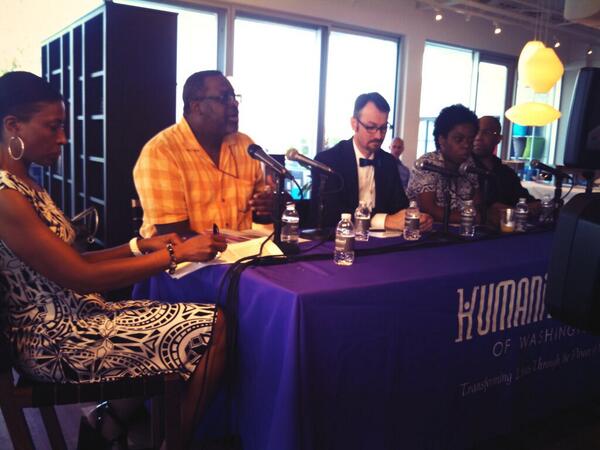
A Few Thoughts on Last Week's DC Community Heritage Project Symposium

Insightful commentary on last week's event from Humanities Council Grants and Special Projects Intern, Sneha Sharma

Washington D.C. residents don’t always have all that much in common with one another. They come from different cultures, backgrounds, and hold a diverse array of professions. Some residents have lived here their whole lives and others just moved in. Often, one of the only things these residents hold in common with one another is the history that surrounds them. Washington D.C. has a rich and extensive history that visually reveals itself through the mix of old and new architecture and the plethora of museums. In order to find a collective sense of community, residents ideally should understand this shared history. 

Not only did the panelists at last week's DC Community Heritage Project Symposium address these abstract ideas, they also discussed the importance of architecture and urban planning in relation to community. Throughout history, racism and rising property prices displaced residents and disrupted any shared sense of community that previously existed. In the present society, residents’ common knowledge of these past events can strengthen their understanding of the community and of each other. Since all the panelists possess strong community ties, they ably discussed how their interactions and work within the community improved when residents identified with their community’s history. Through their statements during the discussion, these panelists all reinforced the idea that a community’s history is always relevant to the present residents whether these residents have been here for five or fifty years. 

After the discussion, I realized that these speakers would never have come together if not for the city’s history that they are all so invested in. This demonstrates the strong sense of community that history can help create. The panel itself was well attended and was followed by a Q and A session where some attendees voiced their personal experiences and opinions in relation to the discussion topic.

(Sharma is a student at The University of California Riverside and is currently studying at the University of California DC Center)