In January, Human Ties posted a brief article from Humanities Council Board Member Aaron Jenkins who attended a rough cut screening of One Common Unity's new documentary film, "The MLK Streets Project."
The completed film's premiere was scheduled to coincide with this weekend's unveiling of the Martin Luther King, Jr. Memorial on the Mall, but may be postponed, along with many other MLK-related activities, due to imminent landfall of Hurricane Irene.
The following article, outlining the project's goals and activities, was contributed by the director. We will keep you posted via Facebook and Twitter (@HumanitiesDC) as we find out whether the premiere and associated events are postponed.

A common joke within the African-American community is that, although Dr. Martin Luther King, Jr. stood for nonviolence, streets named after the civil rights martyr throughout the country are oftentimes marred by crime, vandalism, declining black businesses (if any), and yes, violence. During the summer of 2008, 12 high school students were selected to participate in A NU View, One Common Unity’s youth filmmaking program. They embarked on a historical and investigative filmmaking journey, during which they interviewed families and business owners residing near Martin Luther King Jr. Avenue, SE in Anacostia, researching the history of the neighborhood and its changing socio-economic conditions. The process was replicated for MLK Avenues in 10 other cities around the nation.
The group subsequently developed a documentary exploring the juxtaposition of the current status of Washington, DC’s MLK Ave. and the picture of America that Dr. King painted in his famous “I Have a Dream” speech. The students personally related the progress of Dr. King's dream to a hip-hop generation, all while learning the fundamentals of filmmaking.
Selected with the help of principals and teachers, the students were focused on fostering positive community engagement and building an analysis of the socio-economic forces that keep people living in poverty. A NU View introduces students to alternative career choices in the entertainment industry providing firsthand experience in film production from start to finish. They can draw on their own personal experiences and use the art of story telling as a creative outlet, and a means for community activism. This program increases the participants understanding of Washington’s cultural and social import through an artistic lens, challenging them to think critically about the country and the world in which we live.
Now three years later, this documentary film entitled, “The MLK Streets Project,” is finally set for release. The final product will be screened for audiences in DC through various local film festivals, air on DC Public Access Television, and be shown at high schools and universities through-out the city. While the film is screened at local high schools, One Common Unity facilitators will: host interactive workshops on conflict, resolution, and nonviolence; and facilitate dialogue on the importance of each person telling his or her own story. This exposure will give the students a platform to share their art, open discussion on how to bridge the gap between civil rights and hip-hop, and give them greater awareness of their place in history.
On Sunday, August 28th, 2011, celebrating the 40th Anniversary of the historic March on Washington and coinciding with the unveiling of the national monument dedicated to Dr. King earlier that morning, the film will premiere at the Historic Gala Theatre (3333 14th Street NW) from 1-4PM. The event will include a VIP cocktail reception and a community discussion regarding the current state of MLK streets in relation to his “Dream.”
For more information visit http://www.OneCommonUnity.org .
Friday, August 26, 2011
Tuesday, August 16, 2011
Upcoming Events at the German Historical Society
The Humanities Council will be co-sponsoring a lecture and award presentation with the German Historical Institute and the Black German Cultural Society, NJ beginning this weekend as part of the latter organization's First Annual Conference. Check out the following press releases, and don't miss these unique and informative opportunities!
August 19, 2011, 6:00 - 8:30 pm
Lecture at the German Historical Institute
Speaker: Noah Sow
Noah Sow is an acclaimed journalist, musician, and producer. In 2001, she founded der braune mob e.V., the first anti-racist German media watch organization. Her latest book Deutschland Black & White is based on her extensive experiences as an anti-racism activist.
Her lecture will be the public keynote address of the First Annual Convention of the Black German Cultural Society, Inc. to be held from August 19 to 21, 2011, at the GHI.
The event will also feature an award ceremony for Hans J. Massaquoi, who will be given the “Champion of the Humanities Award” in honor of his lifetime achievements as an author, journalist, and cultural ambassador. Accepting the award on behalf of Mr. Massaquoi will be his son, Hans J. Massaquoi, Jr.
In cooperation with the Black German Cultural Society, Inc. (a New Jersey nonprofit organization) and the Humanities Council of Washington, DC.
The event begins at 6:00 pm and will be held at the German Historical Institute, 1607 New Hampshire Avenue NW (Directions).
It will be followed by a brief reception.
Roots Germania: A Personal Search for Identity
August 18, 2011, 6:00 - 8:00 pm
Film Screening and Panel Discussion at the German Historical Institute
Speakers: Pia Bungarten and Mo Asumang
On the eve of the First Annual Convention of the Black German Cultural Society, the Friedrich Ebert Foundation and the German Historical Institute will host a documentary presentation and lecture on "Roots Germania - A Personal Search For Identity".
The Grimme award nominated documentary "Roots Germania" was directed by Mo Asumang, the daughter of a German and Ghanaian. She decided to search for her own roots and identity, after she received a death threat by the neo-Nazi band White Aryan Rebels, who sing in one song: "This bullet is for you, Mo Asumang." Her search leads her through Germany and then to Ghana, where she speaks with family and friends, but she also engages with NPD party representatives and racist groups to ask questions many would not dare to ask. A discussion moderated by Pia Bungarten (Friedrich Ebert Foundation) with Mo Asumang, the film's direct, will follow the screening.
In cooperation with the Black German Cultural Society, Inc. (a New Jersey nonprofit organization) and the Friedrich Ebert Foundation
The event begins at 6:00 pm and will be held at the German Historical Institute, 1607 New Hampshire Avenue NW (Directions).
Light refreshments will be served following the discussion.
For Both Events Please RSVP (acceptances only) by Tel. 202.387.3355, Fax 202.387.6437 or E-mail events@ghi-dc.org
German Historical Institute 1607 New Hampshire Avenue, NW Washington, DC 20009-2562 Phone: (202) 387-3355 Fax: (202) 387-6437 Email: info@ghi-dc.org
August 19, 2011, 6:00 - 8:30 pm
Lecture at the German Historical Institute
Speaker: Noah Sow
Noah Sow is an acclaimed journalist, musician, and producer. In 2001, she founded der braune mob e.V., the first anti-racist German media watch organization. Her latest book Deutschland Black & White is based on her extensive experiences as an anti-racism activist.
Her lecture will be the public keynote address of the First Annual Convention of the Black German Cultural Society, Inc. to be held from August 19 to 21, 2011, at the GHI.
The event will also feature an award ceremony for Hans J. Massaquoi, who will be given the “Champion of the Humanities Award” in honor of his lifetime achievements as an author, journalist, and cultural ambassador. Accepting the award on behalf of Mr. Massaquoi will be his son, Hans J. Massaquoi, Jr.
In cooperation with the Black German Cultural Society, Inc. (a New Jersey nonprofit organization) and the Humanities Council of Washington, DC.
The event begins at 6:00 pm and will be held at the German Historical Institute, 1607 New Hampshire Avenue NW (Directions).
It will be followed by a brief reception.
Roots Germania: A Personal Search for Identity
August 18, 2011, 6:00 - 8:00 pm
Film Screening and Panel Discussion at the German Historical Institute
Speakers: Pia Bungarten and Mo Asumang
On the eve of the First Annual Convention of the Black German Cultural Society, the Friedrich Ebert Foundation and the German Historical Institute will host a documentary presentation and lecture on "Roots Germania - A Personal Search For Identity".
The Grimme award nominated documentary "Roots Germania" was directed by Mo Asumang, the daughter of a German and Ghanaian. She decided to search for her own roots and identity, after she received a death threat by the neo-Nazi band White Aryan Rebels, who sing in one song: "This bullet is for you, Mo Asumang." Her search leads her through Germany and then to Ghana, where she speaks with family and friends, but she also engages with NPD party representatives and racist groups to ask questions many would not dare to ask. A discussion moderated by Pia Bungarten (Friedrich Ebert Foundation) with Mo Asumang, the film's direct, will follow the screening.
In cooperation with the Black German Cultural Society, Inc. (a New Jersey nonprofit organization) and the Friedrich Ebert Foundation
The event begins at 6:00 pm and will be held at the German Historical Institute, 1607 New Hampshire Avenue NW (Directions).
Light refreshments will be served following the discussion.
For Both Events Please RSVP (acceptances only) by Tel. 202.387.3355, Fax 202.387.6437 or E-mail events@ghi-dc.org
German Historical Institute 1607 New Hampshire Avenue, NW Washington, DC 20009-2562 Phone: (202) 387-3355 Fax: (202) 387-6437 Email: info@ghi-dc.org
Saturday, August 6, 2011
In the Pipeline: Political Activism in Columbia Heights
HCWDC Grantee Bell Clement Discusses Her Current Project
In this article, Clement provides context for her project, and describes her research plan. She hopes to provide regular updates as the project progresses.
The 1960s were a period of transition for the United States. The nation shifted gears as the effects of a generation of prosperity and global power made themselves felt in structural changes to key institutions. In this restless, affluent nation, political activists, in office or on the street, worked to open the next chapter of the American story. Building on decades of advocacy and organizing, civil rights campaigns gained momentum and national attention. In the White House, the Kennedy and Johnson administrations responded to the issues raised by civil rights leaders, and also proclaimed unconditional war on poverty and began to look carefully at conditions in the nation’s cities.
Turmoil in the District of Columbia exemplified the times. Inner city neighborhoods were reeling from the impact of a massive federal “urban renewal” campaign which, starting in the late 1950s,displaced 25,000 residents from the city’s Southwest quadrant. D.C. Public Schools had desegregated immediately on rendering of the Supreme Court’s 1954 opinion in Bolling vs. Sharpe, but citizens’ battles over the implications of that order continued, culminating in the Hanson vs. Hobson (1968) challenge to academic tracking. Locals battled Congressional determination to ram national highway system feeders through old residential neighborhoods – “white men’s roads through black men’s homes”. The ancient campaign for home rule reached its zenith with LBJ’s 1965 full court press for legislation and, in defeat, his creation of an appointed Mayor and council government as an interim step toward residents’ goal of autonomy.
In the midst of this tumult, Columbia Heights was distinguished by the energy of its organizing and advocacy campaigns. Centered on Fourteenth Street, a key retail corridor and the route of one of the first streetcar lines into the neighborhoods from the downtown; bordered on the west by the mansions and consulates of Sixteenth Street, the “Avenue of the Presidents,” and on the east by Howard University, Columbia Heights had always been a hub of commercial and social activity. During the 1950s and early 1960s, the neighborhood experienced rapid transition as black householders took over from white owners, a result of the lifting of restrictive covenants, urban renewal displacements, and school desegregation in D.C., as well as more general economic trends.
When the national political conversation and federal policymakers turned attention to poverty, race inequities, and urban conditions in the mid-1960s, Columbia Heights found itself at the center of implementation action. The Cardozo Heights Association for Neighborhood Growth and Enrichment, Inc. was formed as a subsidiary of the city’s United Planning Organization to implement the Great Society’s 1964 War on Poverty programming in Columbia Heights. CHANGE became a central actor in District-wide battles over the shape of program implementation – and allocation of federal funding – over the next few years. The creation of the Department of Housing and Urban Development in 1965 and its 1966 Model Cities agenda reverberated in the neighborhood as local congregations stepped up to sponsor affordable housing developments on Fourteenth and Sixteenth Streets. In the wake of the violence of April 1968, area residents formed planning and development organizations such as Central Cardozo Concerned Citizens and the Columbia Heights Citizens Association, and claimed the right to direct the neighborhood’s rebuilding.
Project Context: This project will use oral history interviews and supporting research to document this phase of Columbia Heights’ political evolution. This segment of research is built on the results of an inventory of Columbia Heights community history resources, including both witnesses and archival resources, completed with support from the Humanities Council during Summer 2009. Both this and the earlier project are elements of my dissertation research at George Washington University’s Department of History. The dissertation (working title: “Measuring Liberalism: ‘Creative Federalism’, Empowered Citizens, and the Great Society City”; anticipated completion 2012) explores the interaction among federal policymakers, community activists,and the events and ideologies of the decade, in reshaping American concepts of the city, citizenship, and federalism. It is my intention to publish the dissertation in book form.
Wednesday, August 3, 2011
Humanitini Continues!
Tonight's Conversation Tackles a Contentious But Important Topic
Though Humanitini events are meant to be both fun and informative, they can also cover complex and challenging issues. Tonight's Humanitini panelists have been assembled to discuss gentrification; that ever present, yet hazy socio-economic force that at once seems to bring improved standards of living, and increased displacement.
Perhaps one of the biggest problems with gentrification, or new urbanism, is that people are often unwilling to speak openly and honestly about it. Humanitini provides the perfect opportunity for people to express their views on the subject in a safe, judgement-free environment.
Entitled "White House or Black House?," tonight's Humanitini will begin at 6pm at Bar 7. The discussion usually lasts about an hour, and the panelists stick around to talk to the crowd, so stop by whenever you like. The conversation will be led by Rachel Grossman of Woolly Mammoth Theatre Company; scholar Sybil Roberts; Shani Hilton, author of “Confessions of a Black Gentrifier”; scholar Lawrence Guyot; and Jennifer Ragins. Amy Saidman of SpeakeasyDC will moderate.
This Summer's Humanitini series will wrap up next Wednesday with "The ABC's of DC: Americans, Blogs, and Culture." Panelists including Free in DC's Amy Melrose, the Pink Line Project's Philippa Hughes, and the renowned Prince of Petworth will talk about blogging your way to the top!
Monday, July 25, 2011
Living Images in My World: A History Beneath Us
DC Community Heritage Project Teaches Local Students the Historical Value of Cemeteries
DCCHP Intern Bridget Sullivan made a site visit to learn more about one of this Summer's grantee projects, "Living Images in My World: A History Beneath Us - Forgotten Ground Across the River Creek." The project, sponsored by the Columbia Heights Youth Club in partnership with I Saw! The Experience of Learning in DC, uses cemeteries to teach students about local history, and primary source research. In this article Sullivan recounts her experience spending the day with the students and staff.
![]() |
| From the Historical Marker Database |
Yesterday I had the opportunity to join I Saw! The Experience of Learning in DC for the day during their summer program, A History Beneath Us-Forgotten Sacred Ground Across the River Creek. During the four week program, junior high students work with high school leaders to research and create a documentary to restore the identities of African-Americans buried in the Old Methodist-Mount Zion and Female Union Band Cemetery. The students have delved into the history of those interred in the cemetery, and the rich history of the surrounding location. Most of the research has been done with the help of educational partners within the DC community.
My experience with the program began with a bus tour of the area surrounding the cemetery led by historian, Dr. C. R. Gibbs. Gibbs introduced a number of important African-American heritage sites in the immediate vicinity of the cemetery. This dynamic tour was educational, enlightening, and kept everyone moving despite the summer heat. The students had the opportunity to learn the significance of the cemetery and its residents in the context of the historic greater Georgetown neighborhood.
After an impromptu visit to Dumbarton House, an historic house museum near the cemetery, the students had the opportunity to speak with Mr. Neville Waters. Mr. Waters discussed the continuing work of the Afro-American Bicentennial Corporation to restore the cemetery. The AABC fought to save the cemetery in the 1970s against a movement to remove the graves to other locations in order to make room for residential construction in the area. It successfully argued for the historical significance of the site and began the work to clean and restore the cemetery.
Following this discussion, the students visited the cemetery, poured libations in memory of those buried there, and placed flowers on the graves. Overall, this was a great experience and showed great potential for the final documentary. The students are taking full advantage of these unique opportunities to learn about their heritage within the DC community.
Thursday, July 21, 2011
Sex, Scandals, and Social Media
First Event of the Fall 2011 Humanitini Series is a Big Hit
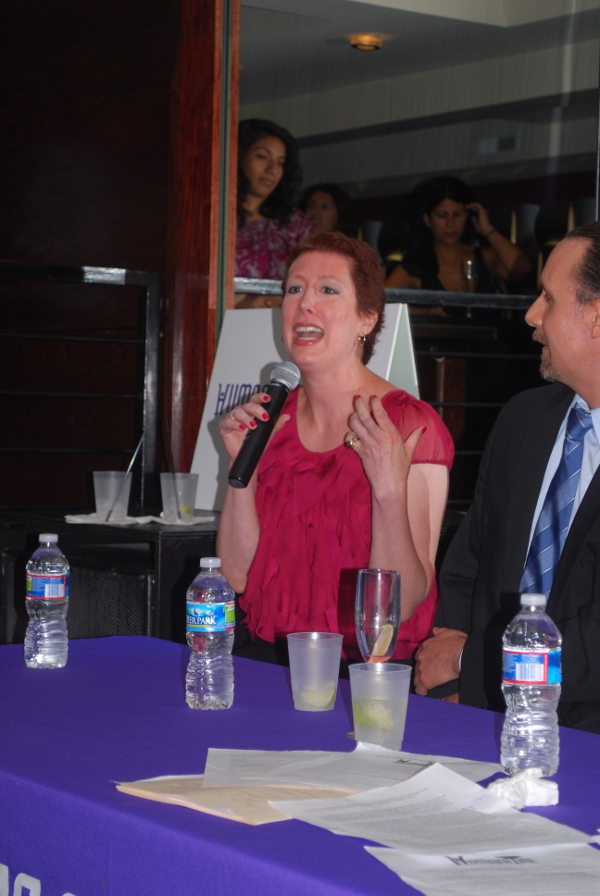
Last night, panelists Stef Woods, Peter Chirinos, Marc Sandalow, and Amy Argetsinger answered questions from moderator Amy Saidman and an engaged audience on sex, politics, and the media. Why do politicians think they can get away with saying one thing and doing another? What do we as a society find so intriguing about their missteps and disgrace? Is it news, or is it a guilty pleasure? Check out some of the images from the program which was held at Bar 7.
Amy Argetsinger of the Washington Post gets things started by addressing the newsworthiness of political sex scandals.
Journalist Marc Sandalow offered a list of past political sex scandals, and many from the audience immediately noticed that the chronicle was almost entirely composed of white men. What are some possible reasons for this apparent racial and gender imbalance?
The audience listened as therapist Peter Chirinos explained that political figures involved in sex scandals tend to get more satisfaction from their affairs the longer they persist.
Attorney and sex blogger Stef Woods asserted that Washington is still, in some ways, a very conservative city; uncomfortable with open discussions of sexuality.
There was plenty of time after the program for the audience to continue the conversation with the panelists over a beer - or, of course, a Humanitini!
The next Humanitini will be held on Wednesday, July 27 at Tabaq (1336 U Street, NW). The panelists will discuss the journey from gay and in the closet to activist for the LGBT community. Clarence J. Fluker of GLBT Affairs, Andrew Barnett of SMYAL, a representative from the Washington Blade, and Christopher Dyer of GLBT Affairs will be in attendance.
Monday, July 18, 2011
Soul of the City Students Tour U Street, Analyze Connection Between Art and Identity
Art Criticism Workshop Conducted by Local Artist Khánh H. Lê and Tour Led By Expert Guide Judith Bauer
This past week, the 2011 Soul of the City students continued their exploration of Washington, DC as a place to make a home. They heard from local artist Khánh H. Lê whose family immigrated to the United States from Vietnam. Lê says his works reflect his ambiguous relation to both Vietnamese and American culture. "Identity" writes Lê, "is the central theme of my works, and I examine it through the bits and pieces of my personal memory and the collective history of the two cultures."
Judith Bauer, who led the students up and down U Street, is an experienced tour guide and expert on the history of the corridor, once the hub of African American culture in Washington, DC. Despite decades of architectural and demographic changes the neighborhood still visibly retains much of the history cultivated during a time when this bastion of black middle-class values flourished in the shadow of Howard University. This heritage can be seen in the surviving African American owned businesses, preserved buildings such as the Prince Hall Masonic Temple and the Bowen YMCA, and Cultural Tourism DC's well demarcated walking tour.
Below are a few students' reactions to the sessions as recorded in their daily journals...
Q. Smith on Lê's family's struggle to gain a foothold in the United States after immigrating from Vietnam to St. Louis, Missouri...
He is from Vietnam, but was raised in America. When he first came to the US, he had nothing. His family only had two thousand dollars to spend, and his father bought a car with it. Then he went to college to be a computer programmer, and shortly after he dropped out. He then received a scholarship to become an artist.
Judith Bauer, who led the students up and down U Street, is an experienced tour guide and expert on the history of the corridor, once the hub of African American culture in Washington, DC. Despite decades of architectural and demographic changes the neighborhood still visibly retains much of the history cultivated during a time when this bastion of black middle-class values flourished in the shadow of Howard University. This heritage can be seen in the surviving African American owned businesses, preserved buildings such as the Prince Hall Masonic Temple and the Bowen YMCA, and Cultural Tourism DC's well demarcated walking tour.
Below are a few students' reactions to the sessions as recorded in their daily journals...
Q. Smith on Lê's family's struggle to gain a foothold in the United States after immigrating from Vietnam to St. Louis, Missouri...
Nateeka Lee on Lê's emotional connection to his work...
Khánh does not like showing his parents his art creations because when he was young his father use to say he should never show his emotions. His father said, “If I hit you, don’t cry.” Plus, he said his creations are personal to him.
Diamond Bynum on the U Street Tour and the African American Civil War Museum...
Mrs. Bauer was a great tour guide. She taught me a lot of stuff about how U Street came to be what it is today. When we went to the museum, Mr. Frank Smith taught us the real history of how the slaves were freed and the how the Emancipation of 1863 came to be.
Kevin Chappell on self-emancipation and African American participation in the Civil War...
When we went to the museum, I did not know what I would learn. I thought I knew everything about how the slaves became free. When I watched the presentation, I learned that Abraham Lincoln did not really free the slaves, but they actually freed themselves.
Next week, Soul of the City moves downtown where they will meet Ward 4 City Councilmember Muriel Bowser at the John A. Wilson Building. They will also visit the Smithsonian Museum of Natural History where they will explore RACE: Are We So Different, a new exhibition which opened on June 18th.
Subscribe to:
Posts (Atom)